What is in iGenics? A closer look at every listed ingredient
This guide examines the ingredients shown in a seller-published iGenics Supplement Facts graphic, explains what research can and cannot tell us, and separates ingredient-level evidence from evidence about the finished product.
Read the label. Then examine the evidence.
This page separates what the supplied Supplement Facts panel appears to list from what clinical research has established. Amounts and ingredient forms should be checked against the current package before purchase.
Use it as a research guide—not as proof that iGenics prevents, treats or improves an eye condition.
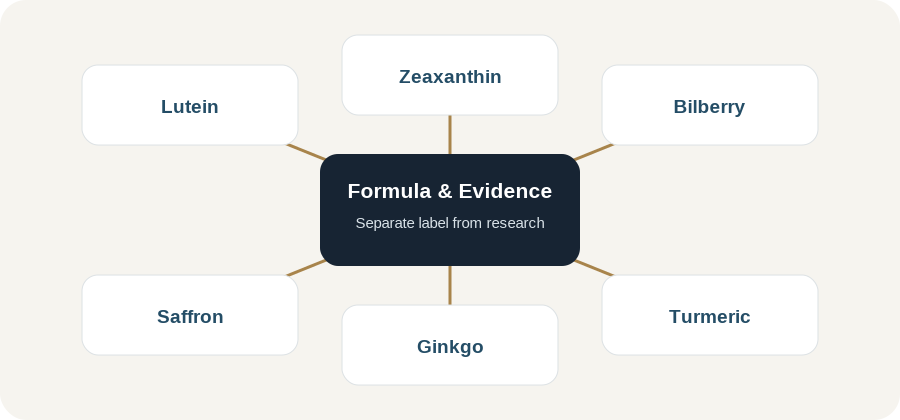
Editorial illustration of ingredient groups. It is not a product photograph or a clinical result.
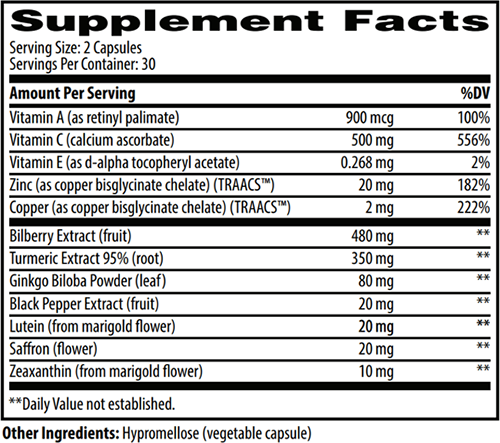
Supplement Facts shown in the supplied image
Use the current physical package as the final reference. The transcribed amounts elsewhere on this site remain subject to label verification, particularly the Vitamin E entry and mineral compound wording.
Seller-provided image. Use is subject to the applicable affiliate-program image-use terms.
What does the published label appear to list?
The seller graphic describes a two-capsule serving and lists 12 ingredients: five vitamins or minerals and seven botanical or carotenoid ingredients. That list is useful for understanding what the seller says is in the formula. It does not establish the quality, absorption, clinical effectiveness or batch-to-batch consistency of the finished supplement.
| Label-listed ingredient | Published amount per 2-capsule serving | Important qualification |
|---|---|---|
| Vitamin A (retinyl palmitate) | 900 mcg | Confirm the unit basis and exact label wording. |
| Vitamin C (calcium ascorbate) | 500 mg | Label-listed form; does not prove an eye-health outcome. |
| Vitamin E (d-alpha tocopheryl acetate) | 0.268 mg | Seller graphic reads 0.268 mg (2% DV); confirm that the current package uses this same label. |
| Zinc | 20 mg | Seller graphic reads zinc bisglycinate chelate (TRAACS); current package not authenticated. |
| Copper | 2 mg | Confirm the compound and amount on the current package. |
| Bilberry extract | 480 mg | Extract ratio and anthocyanin standardization are not confirmed. |
| Turmeric extract | 350 mg | Curcuminoid content and extract specification are not confirmed. |
| Ginkgo biloba powder | 80 mg | Powder is not interchangeable with a standardized leaf extract. |
| Black pepper extract | 20 mg | Piperine percentage is not confirmed. |
| Lutein | 20 mg | Confirm source, form and whether amount is active lutein. |
| Saffron | 20 mg | Plant part and extract standardization are not confirmed. |
| Zeaxanthin | 10 mg | Confirm source, form and whether amount is active zeaxanthin. |
Source: seller-published Supplement Facts graphic reviewed for this draft. These are provisional transcriptions, not independently authenticated batch data.
The supplied seller-published Supplement Facts graphic is legible: it reads vitamin E (as d-alpha tocopheryl acetate) 0.268 mg (2% Daily Value), zinc bisglycinate chelate (TRAACS) 20 mg and copper bisglycinate chelate (TRAACS) 2 mg per two-capsule serving. This is a transcription of the graphic, not authentication of the current physical bottle or the exact variant delivered through the affiliate checkout.
Lutein and zeaxanthin: related nutrients with specific research context
Lutein and zeaxanthin are carotenoids found in foods such as leafy greens and some yellow or orange vegetables. They are also present in the macula, a central area of the retina. Their presence in eye tissue and their study in age-related macular degeneration (AMD) make them relevant to eye-nutrition research. That biological relevance should not be turned into a broad promise that taking any product containing them will improve eyesight.
The strongest clinical context comes from the Age-Related Eye Disease Studies. The National Eye Institute explains that the AREDS2 formula was studied in people with specific stages and risk profiles of AMD. The formula included lutein 10 mg and zeaxanthin 2 mg alongside vitamin C, vitamin E, zinc and copper. AREDS2 supplements can reduce the risk of progression to advanced AMD in appropriate patients; they do not prevent AMD from starting and are not a general vision enhancer for everyone.
The provisional iGenics label lists 20 mg lutein and 10 mg zeaxanthin. Those amounts are higher than the lutein and zeaxanthin quantities shown in the AREDS2 formula, but a higher number does not establish greater benefit. The overall formula, ingredient forms, study population and clinical outcomes differ. iGenics should not be described as equivalent to AREDS2.
Read the dedicated guides: Lutein research and food sources and Zeaxanthin research and AREDS2 context.
Vitamin A, vitamin C, vitamin E, zinc and copper
These nutrients have established roles in normal body function, but that does not mean every dose or combination has been shown to produce a particular eye-health result. Nutrient adequacy, deficiency, total intake from food and other supplements, and personal medical circumstances all matter.
Vitamin A
Vitamin A supports normal vision and other functions. The seller graphic lists 900 mcg as retinyl palmitate. Because retinyl palmitate is a preformed form of vitamin A, the total amount from supplements, foods and medicines matters. High intakes of preformed vitamin A can be harmful, and people who are pregnant or may become pregnant should be especially careful with high-dose retinol-containing supplements. The label amount should be checked in context rather than treated as a reason to add more vitamin A.
Vitamin C
Vitamin C is an essential nutrient involved in normal antioxidant and connective-tissue functions. The provisional label lists 500 mg as calcium ascorbate. Vitamin C was also included at 500 mg in the AREDS2 formula, but that overlap alone does not make two products equivalent. The rest of the formula and the clinical evidence matter.
Vitamin E
Vitamin E is a fat-soluble nutrient with antioxidant functions. It appeared in the AREDS2 formulation at 400 IU, shown by the NEI as 400 IU. The iGenics seller graphic, however, appears to state 0.268 mg. Because that is an unusual figure and cannot be reliably compared with the AREDS2 amount without verifying the label and unit, this page does not convert it, reinterpret it or assume it is a typo. Obtain a clear current Supplement Facts panel or manufacturer clarification.
Zinc and copper
Zinc supports many enzymes and normal immune and cellular functions. Copper is an essential trace mineral. Copper was included in the AREDS and AREDS2 formulations alongside zinc. The seller graphic lists 20 mg zinc and 2 mg copper, and the seller graphic identifies the zinc form as zinc bisglycinate chelate (TRAACS). The current physical package has not been authenticated. The NEI's AREDS2 table lists 80 mg zinc and 2 mg copper. These are not interchangeable formulations, and people should not change their zinc intake or combine products simply to match a trial formula.
High zinc intake can cause adverse effects and can interfere with copper status over time. Zinc can also interact with certain antibiotics. Check total intake from multivitamins and other supplements, and ask a pharmacist or clinician about interactions. For a broader nutrient discussion, see vitamins and minerals for normal eye function.
Bilberry, turmeric, ginkgo, black pepper and saffron
Bilberry extract — 480 mg
Bilberry contains plant compounds including anthocyanins and has a long history of traditional use. It is often marketed for night vision, but the U.S. National Center for Complementary and Integrative Health (NCCIH) says bilberry has not been clearly shown to help any health condition; the more rigorous studies have not found it effective for improving night vision in healthy people. The label's 480 mg amount cannot be compared meaningfully with a study unless the extract specification, composition and study dose are known. See the bilberry evidence and safety guide.
Turmeric extract — 350 mg
Turmeric contains curcuminoids, including curcumin. The amount of turmeric extract is not necessarily the amount of curcumin. NCCIH notes that products vary in curcumin content and that evidence is insufficient for definitive conclusions about many proposed uses. Some enhanced-bioavailability formulations have been associated with liver injury reports. The seller graphic does not disclose a verified curcuminoid percentage, so the 350 mg figure alone does not describe the active curcumin dose. See turmeric and black pepper: evidence and safety.
Ginkgo biloba powder — 80 mg
The seller graphic says powder, not a standardized leaf extract. Those terms are not interchangeable. NCCIH reports no conclusive evidence that ginkgo is helpful for a health condition and notes possible interactions, including increased bleeding risk with anticoagulants such as warfarin. The exact plant part and preparation matter. See ginkgo evidence, preparation and interaction precautions.
Black pepper extract — 20 mg
Black pepper extracts may contain piperine, a compound used in some formulations to affect absorption or bioavailability. But 20 mg of extract does not tell the reader how much piperine is present. The label graphic does not provide a verified piperine percentage. NCCIH notes that some curcumin products combine curcumin with piperine, while also emphasizing that enhanced-bioavailability formulations can differ and may carry safety considerations. Do not assume a specific piperine dose from the extract weight.
Saffron — 20 mg
Saffron has been examined in small studies for several outcomes, including some eye-related research. Small or early studies do not establish that a commercial blend produces the same result. Interpretation requires knowing the extract, active-compound standardization, population, duration and measured outcome. The seller graphic does not establish these details. See saffron research, dosage context and limitations.
How does the listed formula compare with AREDS2?
The table below compares selected amounts transcribed from the seller graphic with the amounts shown in the NEI's AREDS2 table. It is a nutrient comparison only—not a finding that iGenics is an AREDS2 product, has been tested in an AMD trial, or is suitable for someone with AMD.
| Nutrient | Provisional iGenics label | AREDS2 formula | What the comparison can tell you |
|---|---|---|---|
| Vitamin C | 500 mg | 500 mg | Same stated amount; not proof of formula equivalence. |
| Vitamin E | 0.268 mg (verify) | 400 IU | Cannot compare reliably until iGenics label amount and unit are confirmed. |
| Zinc | 20 mg (compound wording unclear) | 80 mg | Different stated amounts and possibly different forms. |
| Copper | 2 mg | 2 mg | Same stated amount; confirm compound on label. |
| Lutein | 20 mg | 10 mg | Higher stated amount does not prove greater effect. |
| Zeaxanthin | 10 mg | 2 mg | Higher stated amount does not prove greater effect. |
AREDS2 amounts are from the National Eye Institute. The iGenics column is provisional seller-label transcription. AREDS2 is intended for specific AMD risk groups under eye-care guidance, not as a general supplement recommendation.
AREDS2 is a tested combination, not a checklist where matching or exceeding a few numbers proves the same outcome. Its results came from a defined clinical trial population and a complete formulation. A product with additional botanicals or different nutrient amounts cannot inherit the trial's results simply because some ingredients overlap.
What would be needed to prove the finished formula works?
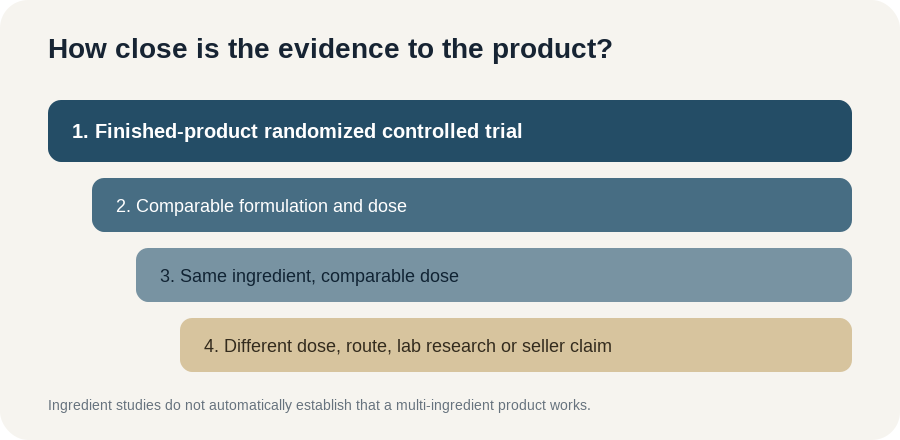
To make a product-specific effectiveness claim, the most relevant evidence would be a well-designed clinical trial of the finished iGenics formula, using the same formulation and serving instructions sold to consumers. The study would need a clearly defined population, an appropriate comparison group, a meaningful follow-up period and outcomes that match the claim being made.
Ingredient studies can help explain why a compound is being researched, but they do not automatically validate a blend. A trial of a standardized ginkgo extract does not establish the effect of an unspecified ginkgo powder. A study of a defined curcumin preparation does not prove the same effect for an extract whose curcuminoid content is unknown. A small saffron study does not establish the result of a multi-ingredient product.
During this review, we have not verified a published controlled clinical trial of the finished iGenics formula. That is not proof that no such study exists; it means the claim should not be made unless the manufacturer supplies verifiable study details. The evidence should identify the product, formula version, dose, study registration or publication, methods and outcomes.
What should you verify before relying on this ingredient list?
| Check | Why it matters | What to request or inspect |
|---|---|---|
| Current Supplement Facts panel | Online graphics can be old or belong to another product version. | Clear photograph of the actual current bottle and serving size. |
| Vitamin E amount and unit | The listed 0.268 mg is unusual and should not be interpreted by guesswork. | Readable label and written clarification if needed. |
| Zinc compound wording | The current graphic's wording is unclear. | Exact mineral source and elemental zinc amount. |
| Botanical specifications | Extract weight alone does not disclose active-compound content. | Plant part, extract ratio and standardization where applicable. |
| Serving size and directions | Amounts per serving can be misread if serving size changes. | Current directions and total daily serving. |
| Checkout identity | The affiliate route and seller information reviewed may not be the same storefront. | Confirm seller, product variant, price and policies at checkout. |
For help interpreting serving size, units and botanical names, read how to read a Supplement Facts label. For questions about possible adverse effects and interactions, visit the iGenics safety guide.
Questions to ask before choosing a multi-ingredient supplement
- Can I see a current, readable Supplement Facts panel for the exact product variant?
- Are the ingredient forms and standardized extract amounts disclosed clearly?
- Have I checked whether another supplement I take already contains vitamin A, C, E, zinc or copper?
- Have I reviewed possible interactions with prescription and over-the-counter medicines?
- Am I expecting a general supplement to do something that requires diagnosis or treatment?
- Have I confirmed the seller, checkout total, shipping terms and return conditions independently?
A clinician or pharmacist can help review the full ingredient list in light of your medicines, health history and dietary intake. This is particularly important if you use anticoagulants, have a planned procedure, are pregnant or breastfeeding, or have been diagnosed with an eye condition.
iGenics ingredients FAQs
Does iGenics contain the AREDS2 formula?
The seller graphic lists several nutrients that also appear in AREDS2, but the amounts are not all the same and the product includes additional botanicals. It should not be described as AREDS2 or as clinically equivalent to it.
Does a higher lutein or zeaxanthin amount mean better results?
No. A higher amount alone does not establish a better clinical outcome. Evidence depends on the complete formulation, ingredient form, population studied and outcome measured.
Is the iGenics vitamin E amount correct?
The supplied seller-published Supplement Facts graphic clearly reads 0.268 mg and 2% Daily Value per two-capsule serving. This is a transcription of that graphic, not authentication of the current physical bottle or the exact variant delivered through the affiliate checkout.
Is the listed ginkgo a standardized extract?
The graphic says ginkgo biloba powder. It does not establish that the ingredient is a standardized leaf extract. Those preparations should not be treated as interchangeable.
Does bilberry improve night vision?
NCCIH reports that the more rigorous studies have not found bilberry effective for improving night vision in healthy people. Traditional use and marketing claims are not proof of benefit.
Does turmeric extract mean the product contains 350 mg curcumin?
No. The label amount is for turmeric extract. Without a verified curcuminoid percentage, the actual curcumin content cannot be calculated.
Can iGenics replace an eye examination or prescribed treatment?
No. A supplement should not replace an eye examination, diagnosis, prescribed treatment or an individualized recommendation from an eye-care professional.
Has the finished iGenics formula been clinically tested?
We have not verified a published controlled clinical trial of the finished formula. Ingredient-level studies do not establish that the complete product has the same effects.
Research sources
- National Eye Institute: AREDS and AREDS2 clinical trials
- National Eye Institute: AREDS/AREDS2 frequently asked questions
- NIH Office of Dietary Supplements: Vitamin A
- NIH Office of Dietary Supplements: Zinc
- NIH Office of Dietary Supplements: Vitamin E
- NCCIH: Bilberry—usefulness and safety
- NCCIH: Ginkgo—usefulness and safety
- NCCIH: Turmeric—usefulness and safety
- NCCIH: Using dietary supplements wisely
Sources support general ingredient and clinical-trial context. They do not verify the current iGenics package label or establish the effectiveness of the finished iGenics formula. Source details and seller label should be rechecked before publication.
Continue your research
Review the evidence, safety and product details together
Explore the main iGenics review, the safety guide and the ingredient-specific articles before making a decision.