How to Read a Supplement Facts Label: Serving Size, Ingredients and Daily Values
Learn how to interpret serving sizes, nutrient amounts, units, botanical extracts, proprietary blends, warnings and product claims before comparing supplements.
In this guide
A practical guide to reading Supplement Facts labels: serving size, amounts, units, Daily Values, botanical extracts, proprietary blends and safety checks.
Educational information; evidence and safety limitations are discussed in the article.How do you read a Supplement Facts label?
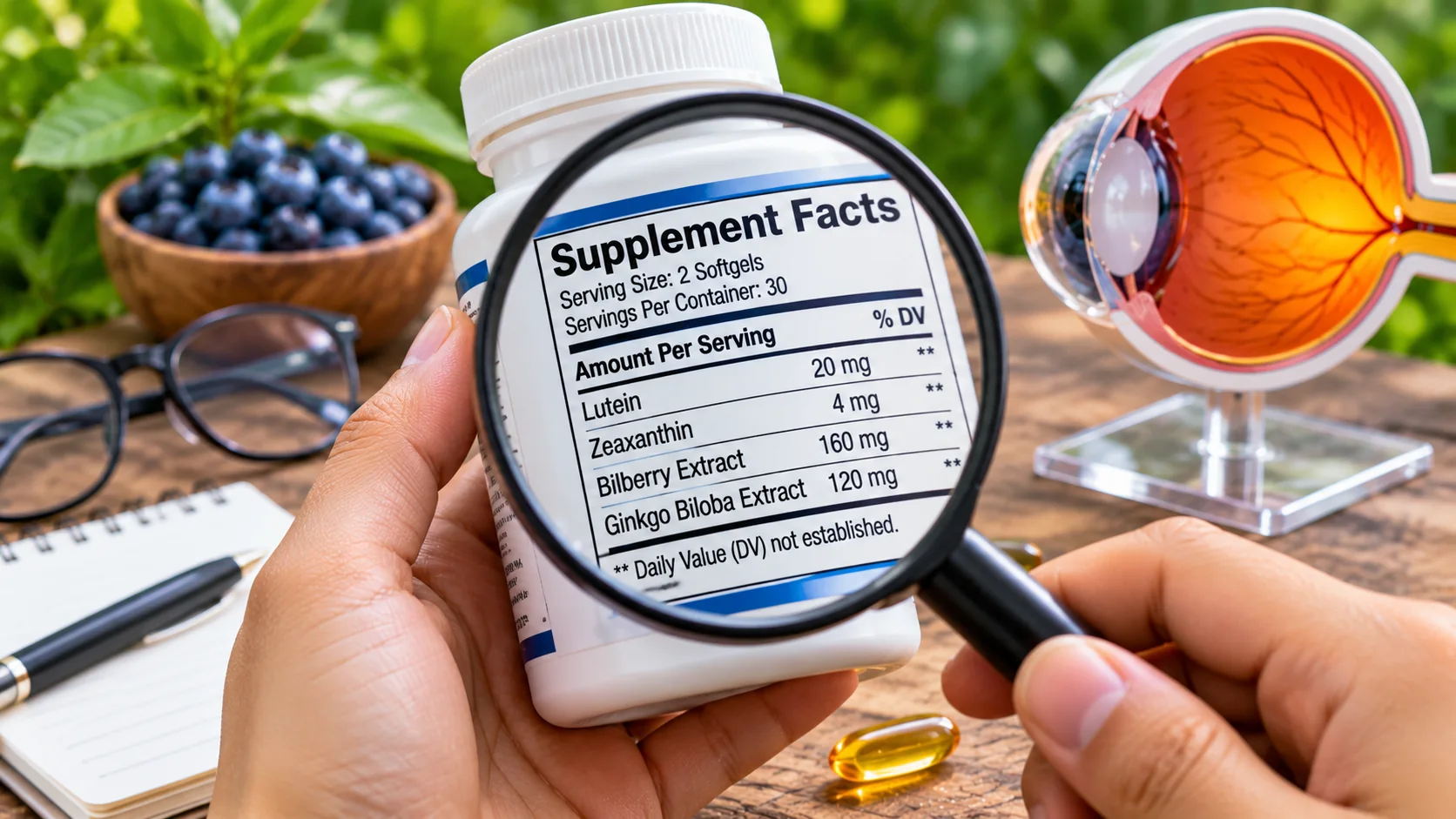
Start with the serving size, not the largest number on the package. The Supplement Facts panel tells you how much of each listed dietary ingredient is present in one serving, how many servings are in the container and, when a Daily Value exists, what percentage of that reference amount the serving provides. Then check the units, nutrient forms, botanical plant parts, other ingredients, directions, warnings and manufacturer contact details.
A label is a description of what the manufacturer declares in the product. It is not independent proof that the product works, that the ingredients are clinically effective at the listed amounts, or that the product has been tested by an independent laboratory. In the United States, FDA does not approve dietary supplements for safety and effectiveness before they are marketed. A consumer should use the label to ask better questions, not treat it as a clinical endorsement.
For iGenics, this distinction matters because the working project transcription includes several nutrient and botanical amounts, but some details remain unverified. In particular, the vitamin E amount has an unresolved unit or transcription discrepancy. A responsible review must preserve that uncertainty until a current, legible label and written manufacturer clarification are available.
Supplement Facts label checklist
| Label item | What to read | Common mistake |
|---|---|---|
| Serving size | Number of capsules or tablets per serving. | Confusing per-capsule amount with per-serving amount. |
| Amount per serving | The quantity listed beside each nutrient or ingredient. | Comparing products with different serving sizes. |
| Daily Value | The %DV where one is provided. | Assuming every botanical has an established %DV. |
| Ingredient form | The named compound, mineral form or botanical extract details. | Treating different forms or extracts as identical. |
| Other ingredients | Fillers, capsule materials, allergens and warnings. | Ignoring ingredients outside the active panel. |
Step 1: Find the serving size and servings per container
Serving size tells you the amount the label uses as one serving. For capsules, this may be one capsule, two capsules or another number. The amount shown beside each ingredient usually applies to that serving, not necessarily to one capsule. If a label says serving size two capsules and lists 500 mg of vitamin C, that means 500 mg per two-capsule serving—not 500 mg in each capsule.
Servings per container estimates how many labelled servings are in the bottle. A bottle containing 60 capsules with a serving size of two capsules provides 30 servings. If the directions say to take two capsules daily, that would represent 30 days at the labelled use. This arithmetic does not tell you whether the serving is appropriate for you or whether the product is effective.
Do not assume that a bigger serving is better. The manufacturer chooses the serving size, and consumers should not increase it to chase a higher amount. More can increase the risk of side effects, interactions or excessive total intake, especially when several supplements contain overlapping nutrients.
Step 2: Understand amount per serving
The amount per serving is the quantity of a listed dietary ingredient in the stated serving. Read the ingredient name and amount together. For vitamins and minerals, the amount may be given in milligrams (mg) or micrograms (mcg). One milligram equals 1,000 micrograms. Confusing these units can produce a thousand-fold error.
For minerals, the label may identify the source compound, such as zinc gluconate or zinc bisglycinate. The declared nutrient amount is not always the same as the total weight of the compound. FDA labeling rules generally require the amount of the dietary ingredient, such as calcium, rather than the total weight of a source salt such as calcium carbonate. If the label is unclear, ask the manufacturer what the stated number represents.
Botanical extracts require additional care. A label may list a weight for an extract, but that does not necessarily disclose the amount of a specific active constituent. For example, 350 mg of turmeric extract is not automatically 350 mg of curcumin. A black pepper extract weight is not automatically the same as its piperine amount. Look for standardization details, plant part, extract ratio and constituent amounts when relevant.
Step 3: Interpret percent Daily Value
The percent Daily Value (%DV) estimates how much a serving contributes to the FDA's reference daily amount for a nutrient. It can help compare a product's contribution with general label reference values. It is not a personalized target, a recommended treatment dose or a measure of how much of a nutrient your body absorbs.
A %DV of 100% does not mean the supplement is 100% effective, and a value above 100% does not automatically mean the product is harmful. Safety depends on the nutrient, total intake from food and other supplements, duration, age, pregnancy status, medical conditions and medicines. Some nutrients have established upper intake levels; others have different safety considerations.
Some botanical ingredients do not have an established Daily Value. The label may show an asterisk or dagger with a footnote such as “Daily Value not established.” That does not mean the ingredient is ineffective or dangerous. It means there is no FDA Daily Value reference for that ingredient. The consumer must look to separate clinical evidence and safety information to assess it.
Step 4: Check nutrient forms and botanical identity
The form of a nutrient can matter. Vitamin E may be listed as d-alpha-tocopherol or another form; vitamin A may be listed as retinyl palmitate or as beta-carotene. Different forms can have different biological properties and conversion factors. Do not convert units or compare values across forms unless a reliable source provides the correct method.
For minerals, identify the form and the declared elemental amount. A label might state “zinc (as zinc bisglycinate chelate).” The phrase in parentheses describes the source form; it does not mean the full weight of the chelate is elemental zinc. If a label contains unclear or contradictory wording, record it as a question for the manufacturer rather than interpreting it by guesswork.
For botanicals, check the common name, scientific name when available, plant part and extract details. Root, leaf, seed, fruit and flower preparations are not interchangeable. A standardized extract may identify a percentage of a constituent, such as a specified percentage of bilberry anthocyanins or ginkgo flavone glycosides. Standardization helps describe composition, but it does not independently prove clinical benefit.
Step 5: Understand proprietary blends
A proprietary blend groups several ingredients under one combined weight. The label may list the individual ingredients in descending order by weight without disclosing each ingredient's exact amount. This can make it difficult to compare the formula with clinical studies or assess whether a specific ingredient is present at a studied dose.
A proprietary blend is not automatically unsafe or ineffective. However, it reduces the amount of dose information available to consumers. If the ingredient amounts are important to safety, interactions or evidence comparison, ask the manufacturer for the quantities or choose a product with more transparent disclosure.
Do not infer that the first ingredient in a blend is present at a clinically meaningful dose. The order only provides limited information about relative weight within the blend. It does not show the amount needed for a health outcome.
Step 6: Read the other ingredients and warnings
The “Other Ingredients” list may include capsule materials, binders, fillers, flow agents, flavors, colors or other components. These ingredients are different from the dietary ingredients listed in Supplement Facts. People with allergies, intolerances, dietary restrictions or religious requirements may need to check them carefully.
Read directions for use and warnings on the full package. Look for age restrictions, pregnancy cautions, allergen statements, storage instructions and advice about medicines or medical conditions. A short product page may omit details present on the physical package. The full label should be checked before use.
The manufacturer, packer or distributor name and place of business should be identifiable. FDA also requires a domestic address or phone number for reporting serious adverse events. Keep the bottle and lot number if you experience a suspected reaction, and contact a healthcare professional. Serious reactions should be reported through the appropriate official channels.
Step 7: Separate label facts from health claims
A Supplement Facts panel tells you what the product declares. Nearby marketing claims may describe structure or function, general wellness or a proposed benefit. Those claims are not the same as a randomized clinical trial showing that the finished product improves a meaningful health outcome. Look for the specific population studied, exact formulation, dose, duration, comparison group and outcome.
Be skeptical of claims such as “clinically proven” when the seller does not identify a trial on the finished product. A study of one ingredient, one branded extract or a different dose does not automatically support the complete product. Likewise, a claim that an ingredient is an antioxidant does not prove that taking the supplement prevents a disease.
In the United States, dietary supplements are not FDA-approved for safety and effectiveness before marketing. Avoid interpreting “FDA registered,” “made in an FDA-registered facility” or similar wording as FDA approval of the product. Manufacturing and facility requirements are not the same as premarket approval of a supplement's effectiveness.
How to compare two supplement labels fairly
First, compare serving sizes. A product with a larger number may simply use a larger serving. Convert both labels to a comparable daily serving only when the directions are clear, and do not recommend changing the labelled serving. Second, compare exact ingredient forms and amounts. Third, check whether botanical extracts identify plant parts, extract ratios or standardized constituents.
Next, compare safety information, warnings, manufacturer transparency, lot testing and the availability of a current certificate of analysis. Ask whether testing is batch-specific and which contaminants or identity measures were checked. A statement such as “third-party tested” is more useful when the company identifies the independent laboratory, testing scope and batch documentation.
Finally, compare cost per labelled serving and the seller's actual purchase terms. Include shipping, taxes, subscription or auto-ship conditions, cancellation process, return eligibility and refund deductions. A low headline price may depend on a multi-bottle bundle or recurring order. Keep the seller's current checkout terms separate from a brand's general marketing page.
Applying the checklist to the provisional iGenics label
The working transcription for iGenics in this project lists a two-capsule serving and 30 servings per container. It also lists vitamin A 900 mcg, vitamin C 500 mg, vitamin E 0.268 mg, zinc 20 mg, copper 2 mg, bilberry extract 480 mg, turmeric extract 350 mg, ginkgo biloba powder 80 mg, black pepper extract 20 mg, lutein 20 mg, saffron 20 mg and zeaxanthin 10 mg. These figures are provisional and must be checked against a current official label.
The supplied seller-published Supplement Facts graphic is legible and reads vitamin E as 0.268 mg (2% Daily Value). Other product descriptions encountered during research have shown different vitamin E figures or units, so the physical package and the variant shipped through the affiliate checkout still need confirmation. Do not silently change 0.268 mg to 268 mg or another amount.
The supplied graphic reads zinc bisglycinate chelate (TRAACS) 20 mg and copper bisglycinate chelate (TRAACS) 2 mg; the current physical package remains unverified. A transcription that appears to combine zinc and copper forms may be an optical-reading or source-label issue. Until the exact line is confirmed, do not publish a definitive chemical form. The listed amount should also be checked as elemental zinc or another declared basis.
The provisional ingredient list does not establish that iGenics is an AREDS2 formula or that the finished product has been tested in a controlled clinical trial. A label can help consumers understand what is claimed to be inside a bottle, but efficacy requires separate evidence. Product-specific clinical evidence has not been verified in this project.
A practical pre-purchase label checklist
Before buying, answer these questions: Is the serving size clear? Do the amounts apply to one capsule or a multi-capsule serving? Are units written clearly? Are the nutrient forms named? Are botanical plant parts and extract details available? Are individual amounts disclosed, or hidden inside a proprietary blend? Are the %DV values understandable? Are warnings and other ingredients visible? Can you identify the manufacturer or distributor and contact them?
Then ask the evidence questions: Does a human trial study the finished product or only one ingredient? Does the trial use the same form and dose? Is the population relevant to your question? Were outcomes clinically meaningful? Are limitations and adverse events reported? Does the product make claims that go beyond the evidence?
For a purchase decision, verify the seller and checkout page independently. Confirm the exact product, package quantity, current price, shipping region, delivery estimate, recurring billing, cancellation route and refund conditions. Save screenshots of the offer and terms at purchase. A return guarantee is a seller policy, not proof that the product is effective or suitable.
Key parts of a Supplement Facts panel
| Label element | What it tells you | What it does not tell you |
|---|---|---|
| Serving size | The quantity used to calculate listed amounts. | How many capsules you personally should take. |
| Amount per serving | Declared quantity of each listed nutrient or ingredient. | Absorption or clinical effectiveness. |
| % Daily Value | How the amount compares with the established Daily Value, where one exists. | Whether the amount is appropriate for your medical situation. |
| Ingredient form | The named chemical form or botanical identity, if disclosed. | Full quality, purity or finished-product performance. |
| Other ingredients | Capsule, flavor, filler and processing components. | A guarantee that the product is suitable for everyone. |
Read the serving size first; all amounts depend on it. Check the current product label rather than relying on an older web transcription.
Frequently asked questions about reading supplement labels
What does serving size mean on a supplement label?
What does serving size mean on a supplement label? It is the amount the label uses for one serving. The listed ingredient quantities generally apply to that serving, not automatically to one capsule.
What is the difference between mg and mcg?
What is the difference between mg and mcg? One milligram equals 1,000 micrograms. Always check the unit before comparing nutrient amounts.
Does 100% Daily Value mean a supplement is effective?
Does 100% Daily Value mean a supplement is effective? No. %DV is a nutrient reference value, not a clinical efficacy score or personalized treatment recommendation.
What does Daily Value not established mean?
What does Daily Value not established mean? It means no FDA Daily Value reference has been set for that dietary ingredient. It does not establish whether the ingredient works or is safe.
Are proprietary blends bad?
Are proprietary blends bad? Not automatically, but they can hide the exact amount of each ingredient, making dose comparison and safety assessment harder.
Does third-party tested mean FDA approved?
Does third-party tested mean FDA approved? No. Third-party testing and FDA approval are different. Ask what was tested, by whom and whether results apply to the current batch.
Can I compare botanical extract milligrams directly with a study dose?
Can I compare botanical extract milligrams directly with a study dose? Only if the extract composition, plant part, standardization and preparation are sufficiently comparable. Total extract weight alone may not be enough.
What should I do if an iGenics label amount conflicts with the website?
What should I do if an iGenics label amount conflicts with the website? Treat the figure as unverified. Obtain a current package-label image and written confirmation before relying on the amount.
Official sources and further reading
- FDA — Questions and Answers on Dietary Supplements
- FDA — Dietary Supplement Labeling Guide: Nutrition Labeling
- NIH Office of Dietary Supplements — Frequently Asked Questions
- NIH ODS — Dietary Supplements: What You Need to Know
Sources checked November 12, 2026. iGenics product label transcription is provisional. Human editorial review and current label verification are pending.