How to Compare Eye-Nutrition Supplements: Evidence, Quality and Price
A practical framework for comparing the full label, ingredient doses, research quality, independent testing, safety, seller identity and total cost—without relying on marketing claims.
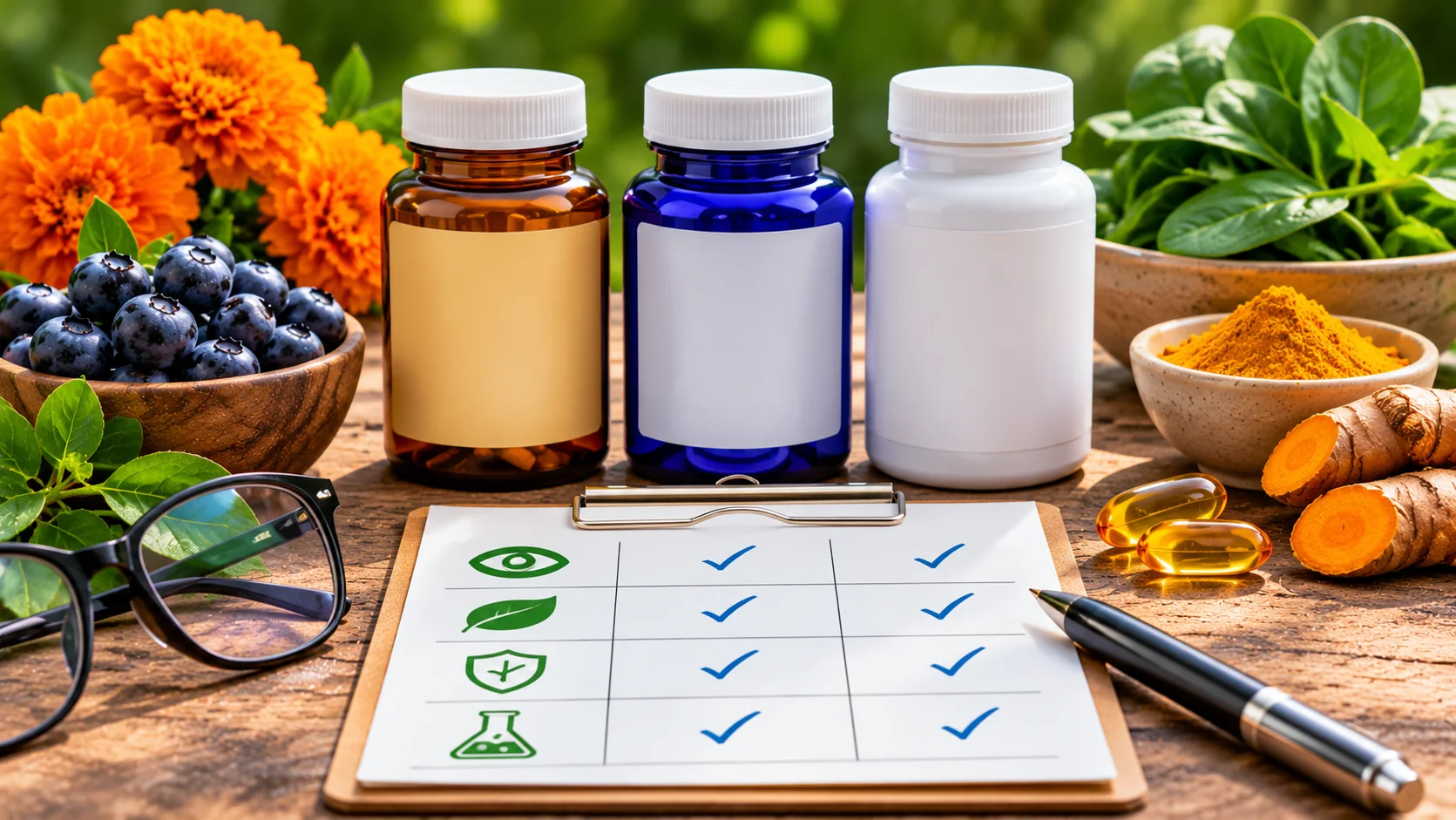
In this guide
A practical, evidence-aware checklist for comparing eye-nutrition supplements: labels, doses, clinical evidence, testing, seller terms, price and safety.
Educational information; evidence and safety limitations are discussed in the article.How should you compare eye-nutrition supplements?
Compare the complete Supplement Facts panel, serving size, ingredient forms and amounts, evidence for the finished product, independent quality information, safety warnings, manufacturer, seller terms and total cost per serving. Ingredient studies do not prove that a finished multi-ingredient formula works. No single badge, ingredient count or marketing phrase can replace this review.
Eye-supplement comparison worksheet
| Comparison item | Product A | Product B |
|---|---|---|
| Serving size | Record capsules per serving. | Record capsules per serving. |
| Amount of each ingredient | Compare exact amounts and forms. | Compare exact amounts and forms. |
| Evidence | Check studies on the same ingredient, preparation and outcome. | Check studies on the same ingredient, preparation and outcome. |
| Quality information | Look for testing and manufacturer transparency. | Look for testing and manufacturer transparency. |
| Total cost | Compare final checkout cost and servings per container. | Compare final checkout cost and servings per container. |
Start with the purpose, not the marketing
Before comparing eye-nutrition supplements, identify the question you need answered. Are you correcting a diagnosed nutrient deficiency, following advice from an eye-care professional, comparing labels, or considering a product marketed for general eye health? Those are different situations. A formula containing nutrients studied in one clinical setting is not automatically appropriate for someone with a different eye condition or health history. If you have a diagnosed eye disease, ask your ophthalmologist whether a supplement has a role in your care. A product page cannot replace an examination or treatment plan.
Marketing phrases such as “supports vision,” “advanced eye formula,” or “clinically inspired” do not establish that the finished product has been tested. Identify the exact outcome being claimed, then look for evidence on that product, at its actual serving, in a relevant population. If that information is missing, mark the claim unverified. Do not fill the gap with research on one ingredient.
Compare the complete Supplement Facts panel
Use the full Supplement Facts panel, not only the front label or a promotional ingredient graphic. Record the serving size, servings per container, each dietary ingredient, amount per serving, units and percent Daily Value where provided. Confirm whether the amount applies to one capsule or to a multi-capsule serving. A bottle containing 60 capsules with a two-capsule serving provides 30 servings, not 60.
Compare like with like. One milligram equals 1,000 micrograms. For minerals, distinguish the declared elemental amount from the weight of the source compound. For botanicals, identify the plant part, extract type, standardization and named constituents if disclosed. A weight such as 350 mg of turmeric extract does not automatically mean 350 mg of curcumin. A quantity of black pepper extract does not automatically disclose its piperine content. A proprietary blend may hide individual amounts and limit comparison.
Check whether the dose can be compared with research
A dose comparison is useful only when the ingredient form and measurement are comparable. Research may use a standardized extract, a particular chemical form, a specific ratio or a defined combination. A retail label may list a generic botanical powder or extract without enough detail to match it to the study preparation. Similar ingredient names do not prove equivalent formulations.
Create an evidence comparison that records the study population, ingredient form, daily amount, duration, outcome measured and study design. Compare each item with the product label. If the label does not disclose the information needed, mark the comparison “not possible from available label details.” Do not assume an extract ratio or active constituent percentage that the manufacturer has not supplied.
A dose used in a clinical trial is not automatically a recommended dose for everyone. Study participants may have a specific diagnosis, age range or medical history, and the research may involve clinical supervision. Ask a qualified clinician before using a study dose to guide personal supplement use.
Separate ingredient evidence from finished-product evidence
Evidence has distance from the product being considered. A controlled trial of the exact finished product is more directly relevant than a trial of one ingredient. A study of a similar ingredient preparation is less direct. Observational research, laboratory work, animal studies and traditional use can generate questions, but they do not establish that a finished supplement improves a clinical outcome.
For every prominent claim, ask: Was the exact product tested? Was the formula identical? Was the study randomized and controlled? How many people participated? What condition did they have? How long were they followed? What outcome was measured? Were results clinically meaningful and replicated? A seller statement that an ingredient is “clinically studied” does not answer these questions. It may mean only that some research exists on the ingredient, not that the product itself was tested.
This distinction matters when comparing iGenics with other products. Research on lutein, zeaxanthin, saffron, bilberry, ginkgo or turmeric must not be presented as proof that the combined iGenics formula works. Ingredients, amounts, preparation and intended population all matter.
Use AREDS2 carefully when comparing eye formulas
The National Eye Institute describes AREDS2 in the context of people with certain stages of age-related macular degeneration (AMD). It is not a general multivitamin recommendation for everyone, and it is not evidence that any product containing one or more of its ingredients will provide the same result. The studied formulation and population matter.
The AREDS2 formula includes specified amounts of vitamin C, vitamin E, zinc, copper, lutein and zeaxanthin. A product containing some of these nutrients but using different amounts, forms or additional botanicals is not equivalent simply because the ingredient names overlap. Compare every ingredient and amount, and do not ignore clinical context. People with no AMD or early AMD should not assume the AREDS2 findings apply to them.
Do not describe iGenics or another commercial product as “AREDS2 equivalent” unless a reliable, current label and appropriate evidence support that exact comparison. Even a close numerical match would not establish the same clinical evidence, manufacturing controls or outcomes.
Look for credible quality testing, and understand its limits
Dietary supplements are not approved by the U.S. FDA for safety and effectiveness before they are marketed. Manufacturers are responsible for meeting applicable requirements, while FDA conducts post-market oversight. Ask whether the manufacturer has product-specific testing for identity, strength, purity and contaminants, and whether a current certificate of analysis is available for the batch being sold.
Independent programs such as USP or NSF may verify certain quality attributes under their own standards. Check the certifier’s directory rather than relying only on a logo printed on a website. Confirm that the exact product and formulation appear in the directory and understand what the certification covers. A certification may address identity, contents, contaminants or manufacturing practices. It does not prove that a product prevents, treats or cures an eye disease.
A statement such as “made in a GMP facility” is not the same as product-specific independent certification. Good manufacturing practices are important, but they do not demonstrate clinical effectiveness. If a seller claims third-party testing, ask who performed it, what was tested, when it occurred and whether the report applies to the current product.
Evaluate the manufacturer and seller separately
A supplement brand, manufacturer, distributor, affiliate marketer and checkout operator may be different businesses. Identify who is responsible for the product, who takes payment, who ships it and who handles returns. Check whether the seller provides a business address, working customer support, clear terms and a process for reporting adverse events. Keep copies of the label, offer and terms at the time of purchase.
Be cautious when a landing page uses a different domain from the manufacturer or product-information site. That does not automatically mean the offer is illegitimate, but it creates a verification task. Confirm that the checkout sells the same product variant, bottle count and formula. Confirm that its shipping, billing and refund terms match the terms you have read. Do not assume that a policy on one storefront applies to a different affiliate checkout.
iGenics has an additional verification issue in this project: the supplied affiliate URL uses Vision Breakthrough, while the product and policy pages reviewed during research are on Science Genics. Until the relationship and checkout terms are reconciled, current prices, shipping and returns should be treated as seller-page observations, not confirmed affiliate-checkout promises.
Compare the full cost, not only the headline price
Calculate cost per serving using the actual number of servings and package price. If a bottle costs $60 and contains 30 servings, the simple pre-shipping cost is $2 per serving. For a bundle, divide the total package price by the total number of servings, then add shipping, taxes or recurring charges that apply. This arithmetic helps compare offers; it does not say whether a product is worth buying or clinically useful.
Check whether the package requires a subscription, auto-ship arrangement or minimum purchase. Look for cancellation instructions, renewal timing, customer-service contact details and return restrictions. A lower advertised per-bottle price may require buying more bottles up front. Consider the total amount paid and the amount of product you can realistically use before it expires.
For iGenics, the seller storefront has displayed package prices, but the affiliate checkout has not been verified against that storefront. Treat those amounts as dated reference points only. Confirm the final checkout total, shipping, taxes and any recurring billing terms before paying.
Review safety and interactions before choosing
A formula with many ingredients is not automatically better. More ingredients can mean more potential interactions, overlapping nutrient intake and difficulty identifying which ingredient caused a side effect. Review the amount of each vitamin and mineral alongside other supplements, fortified foods and medicines you use. Pay particular attention to nutrients with established upper intake levels or known medication interactions.
Botanical ingredients can also interact with medicines. Ginkgo may affect bleeding risk and can interact with anticoagulants. Vitamin E supplements can be relevant to bleeding risk at higher intakes. Turmeric or curcumin products vary by formulation, and some enhanced-bioavailability products have been associated with liver injury reports. Zinc can interfere with absorption of certain medicines. These are ingredient-level considerations, not a prediction of the exact risk of a particular finished formula.
People who are pregnant, breastfeeding, preparing for surgery, taking prescription medicines or managing a chronic condition should consult a clinician or pharmacist before starting a multi-ingredient supplement. Do not stop a prescribed medicine to take a supplement. Seek prompt medical care for sudden vision loss, new flashes or floaters, severe eye pain or other urgent symptoms.
Read warnings, allergens and the full package directions
The front of a bottle rarely contains every detail needed for a decision. Read the directions, warnings, “other ingredients” list, allergen statements, storage instructions and manufacturer contact information. Check whether the product is intended for adults only and whether the label identifies pregnancy or nursing cautions. If you have food allergies or dietary restrictions, verify capsule materials, fillers and processing statements with the manufacturer.
Do not exceed the label directions because a larger amount seems more likely to work. Combining two products can unintentionally duplicate vitamin A, vitamin E, zinc or other nutrients. Keep the bottle and lot number if you experience a suspected reaction, and contact a healthcare professional. Serious adverse events can also be reported through the appropriate regulatory channel.
Use a comparison worksheet instead of a vague score
A numerical “best supplement” score can conceal important differences. A product may disclose its ingredients clearly but have no product-specific clinical trial. Another may have a relevant study but unclear seller terms. Rather than combining unlike qualities into one arbitrary score, record the evidence separately. Use a worksheet with these columns: full label available; serving size clear; ingredient forms disclosed; individual amounts disclosed; product-specific trial identified; independent quality certification verified; warnings available; manufacturer identified; checkout seller confirmed; return terms clear; total cost calculated.
Mark each field “verified,” “not found,” “unclear” or “not applicable.” Do not mark a product as failed merely because a public source is unavailable, but do not treat missing evidence as proof of quality either. If the manufacturer will not answer reasonable questions about label details or testing, record that as a transparency limitation. A careful comparison should show what is known and what remains unknown.
What the current iGenics information does and does not establish
The provisional seller label transcription in this project lists lutein, zeaxanthin, bilberry, saffron, ginkgo, turmeric, black pepper, vitamins A, C and E, zinc and copper. The working serving is described as two capsules. These details must be rechecked against a current, legible label that matches the affiliate checkout before publication. The vitamin E amount has an unresolved discrepancy, and the zinc source wording also requires clarification.
The label transcription does not establish that the product has a finished-product clinical trial, that each botanical is standardized to a particular active constituent, that a current batch certificate is available or that an independent certification applies. The seller’s separate storefront and the supplied affiliate route have not yet been proven to share identical pricing and policies. These details affect dose comparisons, safety interpretation and purchase decisions.
For now, the most accurate conclusion is that iGenics can be assessed as a multi-ingredient supplement using its disclosed label and the available ingredient literature, but important product-specific facts remain unverified. A buyer should resolve those questions before relying on a formula comparison or making a purchase.
A practical checklist before you buy
Before choosing any eye-nutrition supplement, save a copy of the current Supplement Facts panel and confirm the serving size. Check that ingredient names, forms, plant parts and amounts are clear. Compare the product with clinical research only when the preparation and population are meaningfully similar. Look for product-specific evidence separately from ingredient studies. Verify any independent quality certification in the certifier’s directory.
Identify the manufacturer, seller and payment recipient. Read the full shipping, cancellation and return terms for the exact checkout. Calculate the full cost per serving and total cost, including shipping and taxes. Check for subscription terms and keep the order confirmation. Review warnings and discuss potential interactions with a clinician or pharmacist if you take medicines or have a medical condition.
Be wary of disease-treatment promises, guaranteed results, dramatic before-and-after claims, fake urgency or claims that a supplement is “FDA approved.” The FDA does not approve dietary supplements for safety and effectiveness before marketing. A trustworthy comparison is transparent about limitations and does not promise that a product will prevent vision loss or replace eye care.
Questions to ask about every product
| Area | What to verify | Warning sign |
|---|---|---|
| Label | Serving size, amounts, forms and units | Only a front-label graphic is available |
| Evidence | Trials on the exact finished product | Only broad ingredient claims are offered |
| Quality | Current, verifiable independent testing | Unverified seals or vague GMP claims |
| Seller | Manufacturer, payment recipient and support | Checkout identity or terms unclear |
| Safety | Warnings, interactions and total nutrient intake | No full label or safety details |
| Price | Total package cost and cost per serving | Headline price hides recurring charges |
A practical eye-supplement comparison checklist
| Comparison factor | What to compare | Warning sign |
|---|---|---|
| Formula transparency | Full amounts per serving and ingredient forms. | Proprietary blend hides individual quantities. |
| Evidence | Finished-product trials versus ingredient-only studies. | Ingredient research presented as proof of the finished product. |
| AREDS2 context | Exact nutrient amounts and intended AMD population. | Vague “AREDS2-based” wording without formula comparison. |
| Quality information | Manufacturing and credible third-party testing details. | Unverifiable seals or unsupported purity claims. |
| Total cost | Cost per serving, shipping and renewal terms. | Only a headline price is shown. |
A comparison checklist helps identify missing information; it does not independently certify any product.
FAQs about comparing eye supplements
Is the supplement with the most ingredients the best choice?
No. A longer ingredient list does not establish better results. It can make dose comparison and interaction assessment more complicated. Compare evidence, amounts, quality information and safety of the complete formula.
Does a product containing lutein and zeaxanthin equal AREDS2?
No. Ingredient overlap does not make two formulas equivalent. AREDS2 has specified amounts and was studied in particular AMD populations. Compare the full formula and do not assume the same clinical outcomes.
Does third-party testing prove that a supplement works?
No. Quality certification may verify identity, contents, contaminants or manufacturing attributes. It does not establish that the product prevents or treats an eye disease.
What if a supplement uses a proprietary blend?
A proprietary blend may disclose only the combined weight rather than each ingredient amount. That makes dose comparison harder. Ask the manufacturer for more detail or choose a product with clearer disclosure.
How do I compare cost per serving?
Divide the package price by the number of servings, then add shipping, taxes and recurring charges. Check serving size and capsule count before calculating.
Can I take an eye supplement with prescription medication?
Do not assume it is safe to combine them. Some ingredients can interact with anticoagulants, antiplatelet medicines or other drugs. Ask a clinician or pharmacist to review the exact label and medication list.
Is iGenics proven to improve vision?
The information reviewed for this draft does not establish a controlled clinical trial of the exact finished iGenics formula. Ingredient research is not proof that the combined product improves vision.
Does FDA approval mean a supplement is effective?
The FDA does not approve dietary supplements for safety and effectiveness before they are marketed. Be cautious of any seller implying that FDA registration or facility inspection is product approval.
Primary sources
- FDA: Questions and Answers on Dietary Supplements
- NIH Office of Dietary Supplements: Frequently Asked Questions
- NIH ODS: Dietary Supplements—What You Need to Know
- NSF: Dietary Supplement and Vitamin Certification
- National Eye Institute: AREDS and AREDS2
Sources checked November 12, 2026. Seller and product details require re-verification before publication.
Related guides
How to read a Supplement Facts label · Vitamins and minerals for normal eye function · iGenics ingredient breakdown · Safety considerations