Zeaxanthin for Eye Health: Food Sources, AREDS2 Evidence and Supplements
Zeaxanthin is a carotenoid found in the macula and in several colorful foods. It is often discussed with lutein because both were included in the AREDS2 formula studied for certain people with age-related macular degeneration. This guide separates the nutrient's biological role from what clinical research actually established.
In this guide
Understand zeaxanthin, food sources, AREDS2 research, supplement labels and safety. Learn what the evidence does and does not show.
Educational information; evidence and safety limitations are discussed in the article.What is zeaxanthin and what does the evidence show?
Zeaxanthin is a naturally occurring carotenoid found in foods such as orange and yellow peppers, corn, egg yolks and some leafy vegetables. It is also present in the macula, the central region of the retina. Researchers study zeaxanthin alongside lutein because both are concentrated in macular pigment and were included together in the AREDS2 nutritional formula. The clearest clinical context is not a general promise to improve eyesight: it is the use of a specific combination of nutrients to slow progression in some people who already have age-related macular degeneration (AMD).
The National Eye Institute lists 2 milligrams of zeaxanthin and 10 milligrams of lutein in the AREDS2 formula, alongside vitamin C, vitamin E, zinc and copper. The formula was studied as a combination in people at particular stages of AMD. That research does not show that zeaxanthin alone prevents AMD, restores lost vision, treats cataracts or glaucoma, or makes every supplement containing zeaxanthin effective.
The practical takeaway is to separate three questions: what zeaxanthin does in normal biology, what clinical trials found when it was combined with other nutrients, and whether a particular commercial product has been tested. Those are related questions, but they are not interchangeable. A label amount can be compared with a research formula; it cannot by itself prove a health outcome.
Zeaxanthin: food, research and supplement context
| Comparison point | What to look for | What it does not establish |
|---|---|---|
| Relationship to lutein | Both are macular carotenoids and are often discussed together. | They are distinct compounds, not interchangeable label entries. |
| Food sources | Look for foods such as corn, orange peppers and leafy vegetables. | Food sources do not prove a supplement benefit. |
| AREDS2 amount | The AREDS2 formula included 2 mg zeaxanthin with 10 mg lutein. | This is not a universal personal dosage recommendation. |
| Supplement label | Check amount per serving, serving size and other ingredients. | A higher amount is not automatically better. |
How is zeaxanthin different from lutein?
Zeaxanthin and lutein are related plant pigments in the carotenoid family. They are chemically distinct compounds, although they are often discussed together because both occur in the macula. The macula supports detailed central vision. The presence of these pigments in retinal tissue is one reason researchers investigate their roles in eye biology.
The two nutrients are not synonyms and one should not be substituted for the other when reading a supplement label or comparing a formula with a clinical study. AREDS2 used both: 10 mg lutein and 2 mg zeaxanthin. A product listing only lutein is not the same ingredient combination, and a product listing zeaxanthin without lutein is not the same AREDS2 carotenoid pair.
The National Eye Institute explains that lutein and zeaxanthin are carotenoids found in the retina and lens. They may act as antioxidants and absorb some high-energy light. These biological roles help explain scientific interest, but they do not prove that extra supplementation produces a noticeable change in visual sharpness or protects every person from eye disease.
Which foods contain zeaxanthin?
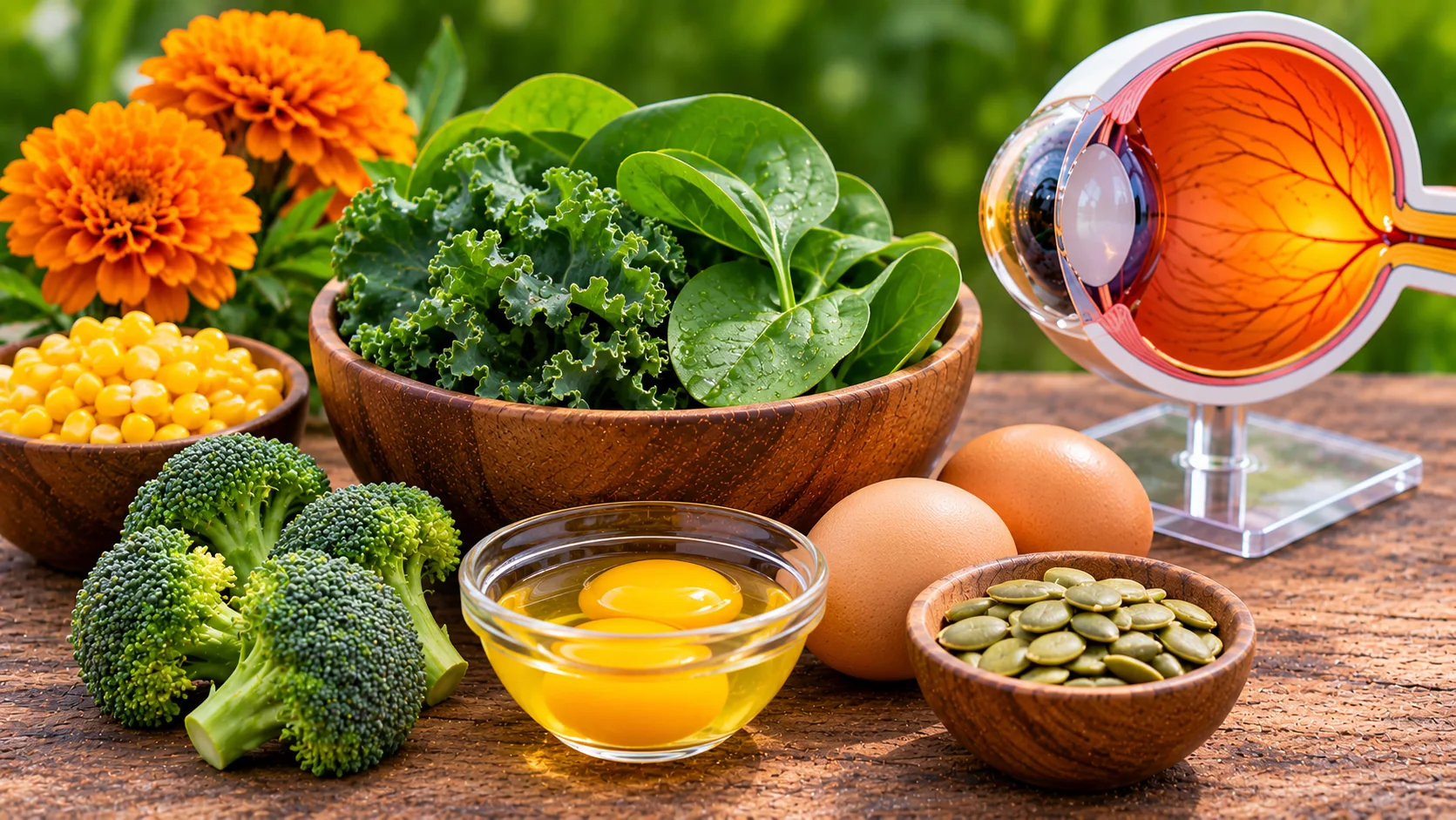
Zeaxanthin occurs in several colorful plant foods. Sweet corn, orange and yellow peppers, orange-colored fruits and some dark-green vegetables can contribute to dietary intake. Egg yolks are another source. Food composition varies with the crop variety, growing conditions, ripeness, storage and preparation, so a food name alone does not establish an exact dose.
A varied eating pattern is generally a more useful starting point than relying on one food or a single so-called superfood. Include a range of vegetables and fruits, and choose foods that are realistic for your budget, preferences and cooking habits. Frozen vegetables can also be practical options. A supplement is not a replacement for dietary variety, and eating a zeaxanthin-containing food should not be presented as a treatment for an eye condition.
Carotenoids are fat-soluble compounds. Eating vegetables as part of a meal that includes some dietary fat may support absorption, but this is a general nutrition principle rather than a promise that a particular meal will change vision. People with restricted diets, digestive conditions or concerns about nutrient intake can discuss those circumstances with a registered dietitian or clinician.
What did AREDS2 actually test?
The Age-Related Eye Disease Study 2 (AREDS2) was a large clinical trial sponsored by the National Eye Institute. It evaluated whether adding lutein and zeaxanthin, omega-3 fatty acids, or both to an existing AREDS nutrient formula affected progression of AMD. The lutein-and-zeaxanthin combination used in the AREDS2 formula was 10 mg lutein and 2 mg zeaxanthin daily. Participants were people already at increased risk because they had intermediate AMD in both eyes, or intermediate AMD in one eye and advanced AMD in the other.
The trial should not be simplified into the statement that zeaxanthin alone prevents blindness. AREDS2 tested a combination and compared formula variations. The National Eye Institute's summary explains that adding lutein and zeaxanthin to the original formula did not create an additional overall benefit in the main primary comparison. Later analyses and long-term follow-up supported replacing beta-carotene with lutein and zeaxanthin in the formula. This is important because beta-carotene was associated with increased lung-cancer risk among current and former smokers.
The NEI reports that AREDS and AREDS2 supplements can reduce the risk of progression from intermediate to advanced AMD by about 25 percent in the relevant population. They do not prevent AMD from starting. The result belongs to the complete research formulation and the studied risk group. It should not be transferred to a different supplement just because that product contains one or two of the same nutrients.
The National Center for Complementary and Integrative Health (NCCIH) summarizes the evidence across eye conditions and notes that results differ by condition and formulation. It describes the AREDS evidence as relevant to slowing progression in people with intermediate AMD and some people with late AMD in one eye. That is narrower than broad marketing phrases such as ‘supports perfect vision’ or ‘prevents age-related eye problems.’
Does zeaxanthin prevent AMD or improve eyesight?
Current clinical evidence does not establish that taking zeaxanthin by itself prevents AMD from developing in people who do not have the disease. Nor does the AREDS2 trial show that a supplement containing zeaxanthin will sharpen normal vision, reverse retinal damage or replace treatment. Prevention of disease onset, slowing progression after diagnosis and changing a vision test are different outcomes. A trustworthy explanation must say which outcome a study measured.
The strongest evidence often quoted in this area concerns the full AREDS2 formula for people with intermediate AMD or certain higher-risk disease patterns. The formula contains several vitamins and minerals as well as lutein and zeaxanthin. It is not possible to isolate the effect of zeaxanthin from that combination based only on the fact that it appears in the formula.
Evidence for other eye conditions should not be borrowed from AMD studies. Research about cataracts, dry eye disease or glaucoma asks different questions and may involve different populations and outcomes. NCCIH notes that dietary supplements have not been shown to treat glaucoma and that there are no supplements recommended as a treatment for cataracts. If someone has a diagnosed eye condition, a supplement should not delay eye examinations or established care.
New or sudden vision changes need prompt professional assessment. Distortion of straight lines, a new central dark spot, sudden loss of vision, flashes, a curtain-like shadow or significant eye pain should not be managed by trying an over-the-counter supplement. A qualified eye-care professional can determine whether symptoms need urgent evaluation.
How much zeaxanthin should a supplement contain?
There is no universal daily zeaxanthin dose that is appropriate for every person or every purpose. The 2 mg amount in AREDS2 is a research-formula amount used with 10 mg lutein and other nutrients in a specific population. It should not be treated as a general target for everyone, nor as proof that a larger amount is better.
When comparing labels, first check the serving size. A bottle may say that it contains 60 capsules, but the serving may require two capsules. The amount listed in the Supplement Facts panel is usually the amount per serving, not necessarily per capsule. Record the zeaxanthin amount, lutein amount, other active ingredients and the number of servings per container before comparing prices or doses.
Next, check whether the formula discloses each ingredient amount separately. If lutein and zeaxanthin are hidden inside a proprietary blend, a consumer cannot reliably compare the individual quantities with the amounts used in AREDS2. Also check whether the product contains overlapping vitamins or minerals that you already take elsewhere. More ingredients can make a formula look comprehensive while making total daily intake harder to assess.
Finally, distinguish a label comparison from a clinical equivalence claim. A product might list 2 mg zeaxanthin, but if it does not contain the rest of the AREDS2 formula in the studied amounts, it is not the AREDS2 formula. If a clinician recommends an AREDS2 product because of an AMD diagnosis, ask them or a pharmacist to check the full label rather than selecting a product based on one matching ingredient.
What should you check before buying a zeaxanthin supplement?
Start with the complete Supplement Facts panel and the serving size, not a large claim on the front of the bottle. Look for separately disclosed amounts of zeaxanthin and lutein. Then review the other vitamins, minerals and botanicals. A multi-ingredient product can create duplicate intake when combined with a multivitamin, another eye supplement or individual nutrient products.
Check the identity of the seller and manufacturer. The label should identify a responsible business and provide a way to contact it. Be cautious when the product page does not show the full label, uses vague claims about proprietary research, or makes disease-treatment promises without accessible evidence. A polished website, an affiliate review or a large number of testimonials does not replace a clinical trial.
Look for credible quality information, but read the wording carefully. A statement that a facility follows manufacturing standards is not the same as independent verification of every finished batch. If a company claims third-party testing, ask what was tested, by whom, when, and whether a current certificate of analysis is available for the specific product or lot. Do not assume a quality seal proves clinical effectiveness.
Compare total cost per serving rather than only the headline bottle price. Include shipping, required serving size, bundle conditions, subscription terms and the seller's return rules. If a multi-bottle offer is cheaper per bottle but requires a larger upfront payment, make that trade-off clear. Confirm the terms on the actual checkout page because an affiliate landing page and a manufacturer's separate storefront may not have identical offers.
Are zeaxanthin supplements safe?
Zeaxanthin is naturally present in foods, and it is included in the AREDS2 formula. That does not mean every high-dose supplement or combination product is automatically appropriate for every person. Safety depends on the full formula, amount, health history, medicines, pregnancy status and total intake from other supplements.
The AREDS2 formula contains substantial amounts of several nutrients. The NEI warns that high-dose AREDS2 supplements can affect digestion and may change how other medicines work in the body. That warning relates to the complete formula, not just zeaxanthin. People considering a high-dose eye supplement should show the full label to a clinician or pharmacist, especially if they take prescription medicines or multiple supplements.
Do not assume that a supplement is suitable during pregnancy or breastfeeding simply because the ingredient also occurs in food. Supplement formulations can include concentrated extracts and additional nutrients. People who are pregnant, breastfeeding, planning pregnancy, managing a chronic condition or taking regular medication should seek individualized advice before starting a multi-ingredient product.
Stop treating a supplement as the answer if symptoms are worsening or vision changes. Supplements are not substitutes for dilated eye examinations, diagnosis, prescribed medicines, injections, surgery or other care recommended by an eye-care professional.
What claims should make you cautious?
Be cautious when a product says it ‘prevents macular degeneration,’ ‘reverses eye damage,’ ‘restores perfect eyesight’ or ‘works for every age.’ Those are disease or outcome claims that require strong evidence for the exact finished product and the population described. A study of a nutrient or a different formula does not substantiate every claim made for a branded blend.
Also be careful with phrases such as ‘clinically proven ingredients.’ That wording can obscure the difference between a published study of an isolated ingredient and a controlled trial of the finished supplement. Ask whether the actual branded formula was tested, whether the trial was randomized and controlled, how many people participated, what outcome was measured, and whether the results were independently replicated.
Testimonials are personal accounts, not reliable estimates of what most customers will experience. Before-and-after images, anonymous reviews and influencer endorsements do not establish that a supplement caused a change. If an online review earns an affiliate commission, that financial relationship should be disclosed clearly near the recommendation.
A responsible product review should say what is known, what is uncertain and what has not been independently verified. It should not imply that a supplement has FDA approval to prevent or treat an eye disease. Dietary supplements are regulated differently from prescription medicines, and FDA facility registration or manufacturing language should never be presented as product approval.
What does the iGenics label say about zeaxanthin?
The provisional iGenics label transcription available for this project lists 10 mg zeaxanthin per two-capsule serving, alongside 20 mg lutein. This is a transcription from a seller-provided label image and must be rechecked against the exact product and checkout offer before publication. It is a product-label fact only; it does not establish that iGenics has been tested in a clinical trial or that it produces the outcomes seen in AREDS2.
The label amounts also differ from the AREDS2 carotenoid amounts: the provisional iGenics transcription lists 20 mg lutein and 10 mg zeaxanthin, while the NEI's AREDS2 formula lists 10 mg lutein and 2 mg zeaxanthin. A higher amount does not mean a better result. The full formula differs as well, so iGenics should not be described as equivalent to AREDS2 based on carotenoid content.
Before relying on the product facts, verify the current Supplement Facts panel, serving size, manufacturer details and offer at the exact affiliate checkout route. The project has also flagged an apparent inconsistency in the seller's vitamin E amount and unit. Until that is resolved, the full label should be treated as provisional. The same caution applies to pricing, bundle terms, shipping and refunds: a separate storefront may not share the affiliate checkout's current terms.
For the broader product assessment, read the full iGenics review and the ingredient breakdown. The purpose of this article is to explain zeaxanthin and its evidence, not to turn an ingredient study into a product endorsement.
When might a conversation with an eye doctor be useful?
If you have been diagnosed with intermediate AMD, ask your ophthalmologist whether an AREDS2 formulation is appropriate for your specific diagnosis. The recommendation depends on disease stage and findings in each eye. Do not assume that any eye-health supplement is interchangeable with the formula used in the clinical research.
If you have no AMD diagnosis and are considering zeaxanthin for general wellness, focus first on dietary variety and routine eye care. There is no basis for promising that a supplement will prevent AMD in a person who does not have it. If your diet is restricted or you have a reason to suspect a nutrient gap, discuss that specific concern with a qualified clinician or dietitian.
If you take multiple medicines or supplements, bring a complete list to the appointment. Include product names, serving sizes and how often you take them. This helps the clinician identify duplicate nutrients and possible interactions. Keep the actual packaging or a clear photograph of the Supplement Facts panel so the review is based on the formula you use.
If a seller uses a strong disease claim, ask for the finished-product clinical evidence rather than accepting a link to a study about zeaxanthin generally. A useful question is: ‘Was this exact product, at this exact serving, tested in people with the condition named in the advertisement?’ If the answer is unclear, treat the claim as unverified.
Lutein and zeaxanthin: a practical comparison
| Feature | Lutein | Zeaxanthin |
|---|---|---|
| Relationship | A macular carotenoid. | A related but distinct macular carotenoid. |
| Food sources | Dark leafy greens, peas, broccoli and egg yolks. | Leafy greens, corn, orange peppers and egg yolks. |
| AREDS2 amount | 10 mg in the AREDS2 formula. | 2 mg in the AREDS2 formula. |
| Interpretation | Studied together in a defined combination. | Not evidence that either ingredient alone prevents AMD. |
The listed AREDS2 amounts describe a specific research formulation, not individual supplement advice.
Frequently asked questions about zeaxanthin
Is zeaxanthin the same as lutein?
No. Zeaxanthin and lutein are related but distinct carotenoids. Both are found in the macula and were used together in the AREDS2 formula.
What foods are high in zeaxanthin?
Sweet corn, orange and yellow peppers, egg yolks and some leafy vegetables can contribute zeaxanthin. Amounts vary, so food lists should not be treated as precise dose charts.
How much zeaxanthin was used in AREDS2?
The AREDS2 formula contains 2 mg zeaxanthin with 10 mg lutein, plus vitamin C, vitamin E, zinc and copper. It was studied as a combination for people at particular stages of AMD.
Does zeaxanthin prevent macular degeneration?
Evidence does not establish that zeaxanthin alone prevents AMD from developing. AREDS2 evidence concerns slowing progression in certain people who already have AMD.
Is more zeaxanthin better?
Not necessarily. A higher label amount does not prove greater benefit, and the 2 mg AREDS2 amount was studied as part of a specific formula rather than as a universal dose target.
Can zeaxanthin restore lost eyesight?
No clinical evidence establishes that zeaxanthin supplements restore vision already lost from retinal damage or replace eye-disease treatment.
Is zeaxanthin safe with medication?
Safety depends on the complete supplement formula and your medicines. High-dose eye formulas can affect digestion or how medicines work, so ask a clinician or pharmacist to review the label.
Does iGenics contain zeaxanthin?
The provisional seller-label transcription for this project lists 10 mg per two-capsule serving. Confirm the current label and checkout offer before relying on that amount; it does not establish product effectiveness.
Sources and further reading
- National Eye Institute — AREDS 2 Supplements for Age-Related Macular Degeneration.
- National Eye Institute — AREDS/AREDS2 Frequently Asked Questions.
- National Eye Institute — AREDS/AREDS2 Clinical Trials.
- National Center for Complementary and Integrative Health — Dietary Supplements for Eye Conditions: What the Science Says.
- NIH Office of Dietary Supplements — Vitamin A and Carotenoids.
Last reviewed for this draft: November 12, 2026. Source pages and product facts must be rechecked before publication. This article is educational information, not individual medical advice. It has not been medically reviewed and requires human editorial review.