Bilberry for Eye Health: Night Vision, Research and Safety
Bilberry is widely marketed for vision and night-vision support. But the strongest evidence summaries are cautious. This guide examines what human studies have found, why the popular night-vision story is not proof, and what consumers should check before buying an extract.
In this guide
What research says about bilberry extract, night vision, screen-related eye fatigue, safety, interactions and supplement labels.
Educational information; evidence and safety limitations are discussed in the article.Does bilberry help eyesight or night vision?
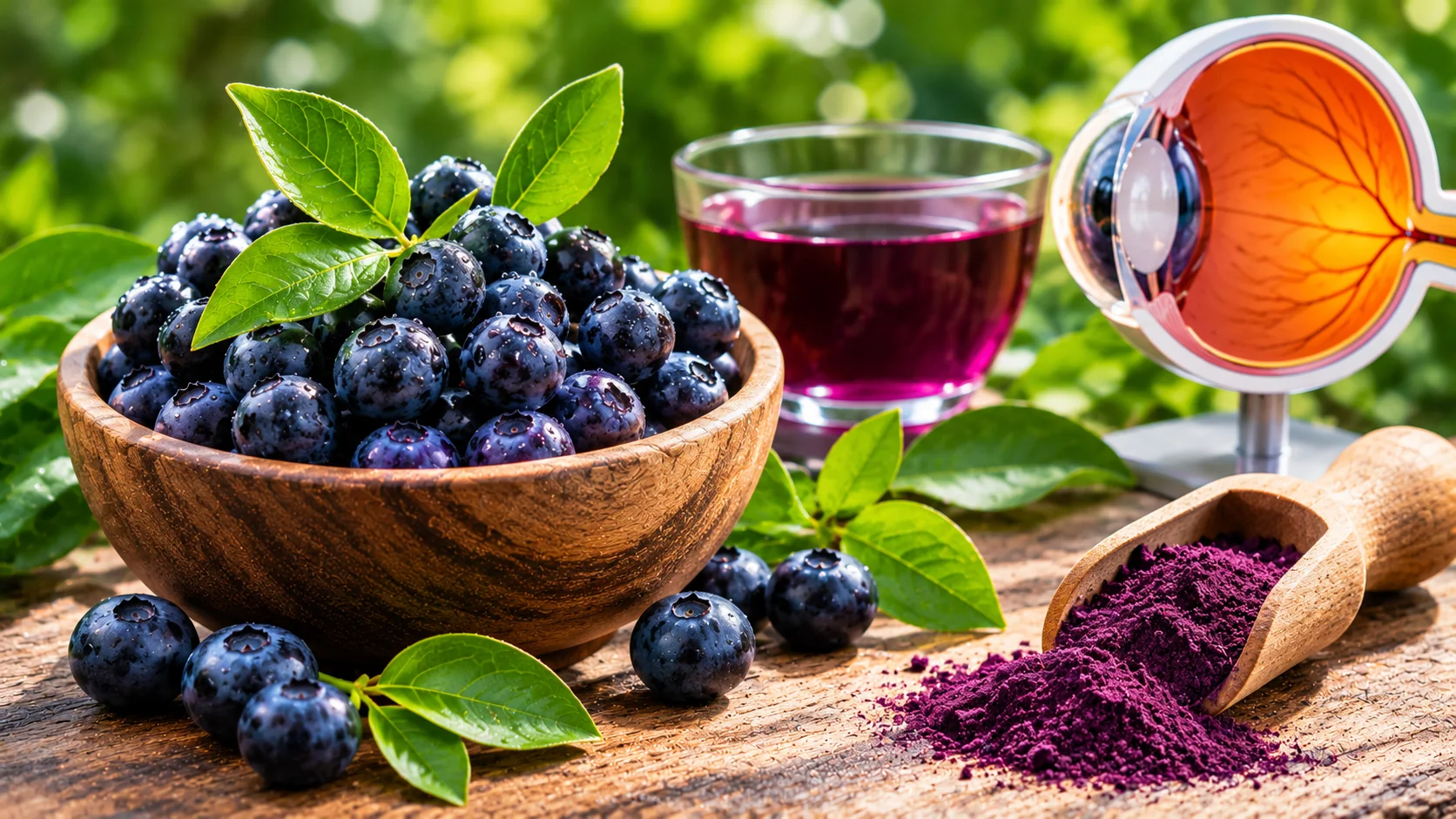
Bilberry (Vaccinium myrtillus) is a small dark berry related to blueberry. Its fruit contains plant compounds called anthocyanins, which have attracted research interest because of their antioxidant activity in laboratory settings. Bilberry has a long history of traditional use, including for vision. However, current human evidence does not clearly show that bilberry improves eyesight, prevents eye disease or reliably improves night vision in healthy people.
The U.S. National Center for Complementary and Integrative Health (NCCIH) says bilberry has not been clearly shown to help any health condition. Studies of night vision have produced conflicting results, much of the research has been low quality, and the most rigorous studies have not found bilberry effective for improving night vision in healthy people. This is a more cautious conclusion than many supplement advertisements suggest.
Some small studies have explored bilberry extracts and symptoms such as screen-related eye fatigue. Those findings do not establish that bilberry treats dry eye, improves visual acuity, prevents macular degeneration or benefits everyone who uses a computer. The result from one study must be interpreted in light of its sample size, extract, dose, duration, outcome and whether other studies reproduce it.
How to evaluate bilberry claims
| Claim or question | What to examine | Caution |
|---|---|---|
| Night vision | Look for well-designed human trials measuring night-vision outcomes. | Traditional use or anecdotes are not proof. |
| Eye strain | Check whether studies examine the same symptom and extract preparation. | Results from one preparation may not apply to another. |
| Extract quality | Look for botanical identity, extract ratio and standardization details. | A generic bilberry amount may not describe anthocyanin content. |
| Finished formula | Check whether the complete product itself has been tested. | Ingredient research does not prove iGenics works. |
What is bilberry and how is it different from blueberry?
Bilberry is the fruit of Vaccinium myrtillus, a shrub native to parts of Europe and northern regions of North America and Canada. It resembles a blueberry, but the two are not identical species. Bilberry is also known by names such as European bilberry and whortleberry. The fruit is eaten as food and used to make extracts, jams and other products.
The fruit contains anthocyanins and other polyphenols. These compounds give berries their deep color. Laboratory research has explored antioxidant and other biological activity, but laboratory findings are not proof of a clinical benefit in people. A substance may show activity in a test tube or animal model without producing a meaningful health outcome when taken as a supplement.
The fruit and leaves should not be treated as interchangeable. NCCIH notes that bilberry fruit is generally considered safe in amounts commonly found in foods, while bilberry leaves may be unsafe when used in high amounts or for long periods. A product that does not clearly identify which plant part it uses is harder to assess.
Does bilberry improve night vision?
The popular story says British pilots ate bilberry jam during World War II and gained better night vision. NCCIH notes that this story may have been superstition or a deliberate hoax intended to conceal improvements in radar technology. The story helped fuel scientific interest, but a memorable historical anecdote is not clinical proof.
A systematic review of placebo-controlled trials published in 2004 examined bilberry anthocyanosides for night vision. It found that the evidence from rigorous clinical studies did not support the idea that bilberry improves normal night vision. Most participants in the trials had normal or above-average eyesight, and the review found an absence of rigorous research in people whose night vision was impaired by an eye condition.
The American Academy of Ophthalmology has likewise stated that there is no conclusive scientific evidence supporting bilberry extract for night vision. This does not mean that every possible effect has been ruled out forever. It means the available evidence is not strong enough to support confident marketing claims that bilberry improves night vision in healthy people.
Night-vision problems can have many causes, including refractive error, cataracts, retinal conditions, medication effects and other health issues. If you struggle to see in dim light, have difficulty driving at night or notice a recent change, arrange an eye examination rather than relying on a berry supplement.
Can bilberry reduce digital eye strain?
A few human studies have investigated bilberry extract in people who experience eye fatigue during screen use. One randomized, double-blind, placebo-controlled study published in 2015 examined 281 office workers who used visual display terminals. After screening, 88 participants were enrolled and received either bilberry extract at 480 mg per day or placebo for eight weeks. The study reported improvement in some measures and self-reported symptoms in the bilberry group.
That result is interesting but should not be stretched beyond the study. The enrolled sample was much smaller than the number screened, the intervention lasted eight weeks, and the result concerns a defined group and extract. It does not establish that all bilberry products use the same extract, that the benefit is durable, or that bilberry prevents eye disease. It also does not prove that screen-related discomfort is caused by a nutrient deficiency.
A 2022 systematic review and meta-analysis of interventions for computer vision syndrome reported low-certainty evidence of no clear improvement in visual fatigue scores for oral berry-extract supplementation compared with placebo across the pooled studies. The authors noted substantial heterogeneity. This illustrates why an individual positive trial should be read alongside the wider body of evidence.
For common screen-related discomfort, practical steps may be more useful: take regular breaks, blink fully, adjust glare and screen distance, use appropriate corrective lenses and seek an assessment for persistent symptoms. These measures do not require assuming that bilberry is effective.
What does the overall research say?
The most useful high-level summary comes from NCCIH: bilberry has not been clearly shown to help any health condition. Studies have often been small or methodologically weak, making it difficult to draw definite conclusions. This is not the same as saying that every bilberry preparation has been tested and proven ineffective for every possible outcome. It means the evidence does not currently justify broad benefit claims.
Research results can differ because bilberry supplements are not all identical. Extracts may vary in plant source, plant part, anthocyanin content, processing, dose and quality controls. A trial using one standardized extract cannot automatically substantiate a product that uses a different extract or an unspecified amount of bilberry powder.
The outcome matters too. A study may measure a laboratory marker, a questionnaire score, a visual function test or the development of a diagnosed disease. Those outcomes are not interchangeable. A change in one symptom score does not prove that a supplement prevents blindness, protects the retina or improves overall eyesight.
When reviewing a product claim, ask four questions: Was the finished product tested? Was the study randomized and controlled? Did it measure the outcome named in the advertisement? Have independent researchers replicated the finding? If those answers are unavailable, describe the claim as unverified rather than established.
Is bilberry safe? What about medicines?
NCCIH says bilberry fruit is considered safe when eaten in amounts typically found in foods. Fruit extracts have been used in research at doses up to 160 mg per day for periods up to six months and appear to have been well tolerated in those studies. These observations do not establish long-term safety for every extract, dose or combination product.
Bilberry leaves raise different concerns. NCCIH warns that leaves may be unsafe in high doses or when used for long periods. Consumers should check whether a product contains fruit, leaf or a mixture. If the label does not clearly identify the plant part, ask the manufacturer before using it.
People taking medication should speak with a healthcare professional before using bilberry or another herbal product. Memorial Sloan Kettering notes a reported case of excessive bleeding associated with long-term bilberry use alongside a newly prescribed blood-thinning medicine, and advises caution with warfarin and other blood thinners, aspirin and NSAIDs. A case report does not quantify the risk for every person, but it is a reason not to assume that an herbal supplement is interaction-free.
There is limited information about the safety of supplemental amounts during pregnancy or breastfeeding. People who are pregnant, breastfeeding, planning pregnancy, taking regular medication or managing a chronic condition should seek individualized advice before using concentrated extracts. Food use and high-dose supplement use are different exposures.
How do you compare bilberry supplements?
Read the Supplement Facts panel and identify whether the product contains bilberry fruit extract, fruit powder, leaf extract or a blend. Check the amount per serving and how many capsules make up that serving. If the product lists only a proprietary blend, the individual bilberry amount may not be disclosed, which makes meaningful comparisons difficult.
Look for information about standardization, such as the amount or percentage of anthocyanins, but do not treat standardization as proof of clinical effectiveness. It helps describe the extract; it does not establish that the product improves night vision or treats an eye condition. A manufacturer should also be able to identify the botanical species and plant part used.
Check for other ingredients. An eye supplement may combine bilberry with lutein, zeaxanthin, vitamins, minerals and other botanicals. Review the complete formula for duplicate nutrients and potential interactions. If you already use a multivitamin, an AREDS2 product or prescription medicines, ask a pharmacist or clinician to review the combined list.
Compare cost per serving, not just the bottle price. Check shipping, bundle conditions, subscription or auto-ship terms, return eligibility and the actual seller. A product page may show a promotional bundle that differs from the checkout terms. Save a copy of the offer and policies at the time of purchase if you need to refer to them later.
Does the iGenics formula include bilberry?
The provisional iGenics product-label transcription used for this project lists 480 mg of bilberry extract per two-capsule serving. This amount must be rechecked against the current official label and the exact affiliate checkout offer before publication. The label amount is a product fact only; it does not show that the finished iGenics formula has been tested in a clinical trial or that it improves night vision, reduces digital eye strain or prevents an eye disease.
The 2015 screen-related eye-fatigue study used 480 mg per day of a specific bilberry extract, but matching the number on a label is not enough to establish equivalence. The extract's composition, standardization, manufacturing, participant group, study conditions and measured outcomes all matter. The study does not prove that iGenics uses the same extract or delivers the same result.
The broader evidence summary from NCCIH remains cautious: bilberry has not been clearly shown to help any health condition, and rigorous studies have not found it effective for improving night vision in healthy people. For this reason, the iGenics review should describe bilberry as an included ingredient with limited and uncertain clinical evidence, not as a proven night-vision enhancer.
For the complete formula and its limitations, read the full iGenics review and ingredient breakdown. The product's current label, checkout offer, refund terms and image permissions still require final verification.
What should you do if you are considering bilberry?
If you enjoy bilberries as food, they can be part of a varied diet. That is different from taking a concentrated extract for a medical purpose. Do not assume that the traditional use of a berry establishes the effectiveness of a supplement.
If you are considering bilberry for night vision, the current evidence does not support expecting a reliable improvement. If night vision has changed, arrange an eye examination to identify the cause. If you are considering bilberry for screen-related discomfort, understand that small trials have mixed results and do not replace basic screen habits or an assessment of persistent symptoms.
If you have an eye diagnosis, ask your ophthalmologist which treatments or supplements, if any, are appropriate for your condition and stage. Do not replace prescribed treatment with bilberry. If you take blood thinners, aspirin, NSAIDs or other regular medication, ask a pharmacist or clinician to check for interactions before using a concentrated extract.
Finally, evaluate marketing claims carefully. Ask for research on the exact finished product, not only a study of bilberry as an ingredient. If the seller cannot provide that evidence, the honest conclusion is that the product-specific benefit is unverified.
Bilberry claims versus what evidence can establish
| Common claim | What to ask | Evidence caution |
|---|---|---|
| Night vision | Were outcomes measured in controlled human trials? | Traditional use or laboratory activity does not prove improved night vision. |
| Digital eye strain | Was screen-related discomfort measured with validated outcomes? | Evidence is not strong enough to promise relief. |
| Antioxidant activity | Was the effect observed in a lab, animals or people? | Laboratory antioxidant activity is not a clinical eye-health outcome. |
| Extract quality | Is anthocyanin standardization disclosed? | A milligram amount alone does not describe extract composition. |
Separate the specific preparation and study population from broad marketing claims.
Frequently asked questions about bilberry extract
Does bilberry improve night vision?
Rigorous clinical studies have not shown bilberry to improve night vision in healthy people. The popular pilot story is not clinical evidence.
Is bilberry the same as blueberry?
No. Bilberry (Vaccinium myrtillus) is related to blueberry but is a different species. Products should identify the botanical name and plant part.
Can bilberry help with computer eye strain?
One small randomized trial reported improvement in some screen-related eye-fatigue measures, but the wider evidence is mixed and low certainty. It is not proof that all bilberry products work.
What is the active compound in bilberry?
Bilberry contains anthocyanins and other plant compounds. Their biological activity does not by itself establish a clinical benefit in people.
Is bilberry safe to take every day?
Food amounts of bilberry fruit are generally considered safe, but long-term safety of concentrated extracts is less certain. Bilberry leaves may be unsafe at high doses or with prolonged use.
Can bilberry interact with blood thinners?
There are reports and clinical cautions about possible bleeding interactions, particularly with anticoagulants and medicines such as aspirin or NSAIDs. Ask a clinician or pharmacist before combining them.
Does iGenics contain bilberry?
The provisional seller-label transcription lists 480 mg per two-capsule serving. Confirm the current label and checkout offer; this amount does not establish that the finished product works.
Can bilberry prevent macular degeneration?
Current evidence does not establish bilberry as a way to prevent AMD. Do not use it instead of recommended eye examinations or treatment.
Sources and further reading
- National Center for Complementary and Integrative Health — Bilberry: Usefulness and Safety.
- Canter and Ernst — Anthocyanosides of Vaccinium myrtillus for night vision: a systematic review of placebo-controlled trials.
- Ozawa et al. — Bilberry extract supplementation for preventing eye fatigue in video display terminal workers.
- American Academy of Ophthalmology — Can Supplements Improve Night Vision?.
- American Journal of Ophthalmology — Interventions for the Management of Computer Vision Syndrome: A Systematic Review and Meta-analysis.
- Memorial Sloan Kettering Cancer Center — Bilberry Fruit.
Last reviewed for this draft: November 12, 2026. Source pages and product facts must be rechecked before publication. This article is educational information, not individual medical advice. It has not been medically reviewed and requires human editorial review.