Lutein for Eye Health: Food Sources, Supplements and What Research Shows
Lutein is a carotenoid found in leafy greens and in the human retina. It is also included in the AREDS2 supplement formula studied for certain people with age-related macular degeneration. Here is what that evidence means—and what it does not prove about every lutein supplement.
In this guide
Learn what lutein is, where it occurs in food, what AREDS2 research does and does not show, and how to assess lutein supplements.
Educational information; evidence and safety limitations are discussed in the article.What is lutein and does it help eye health?
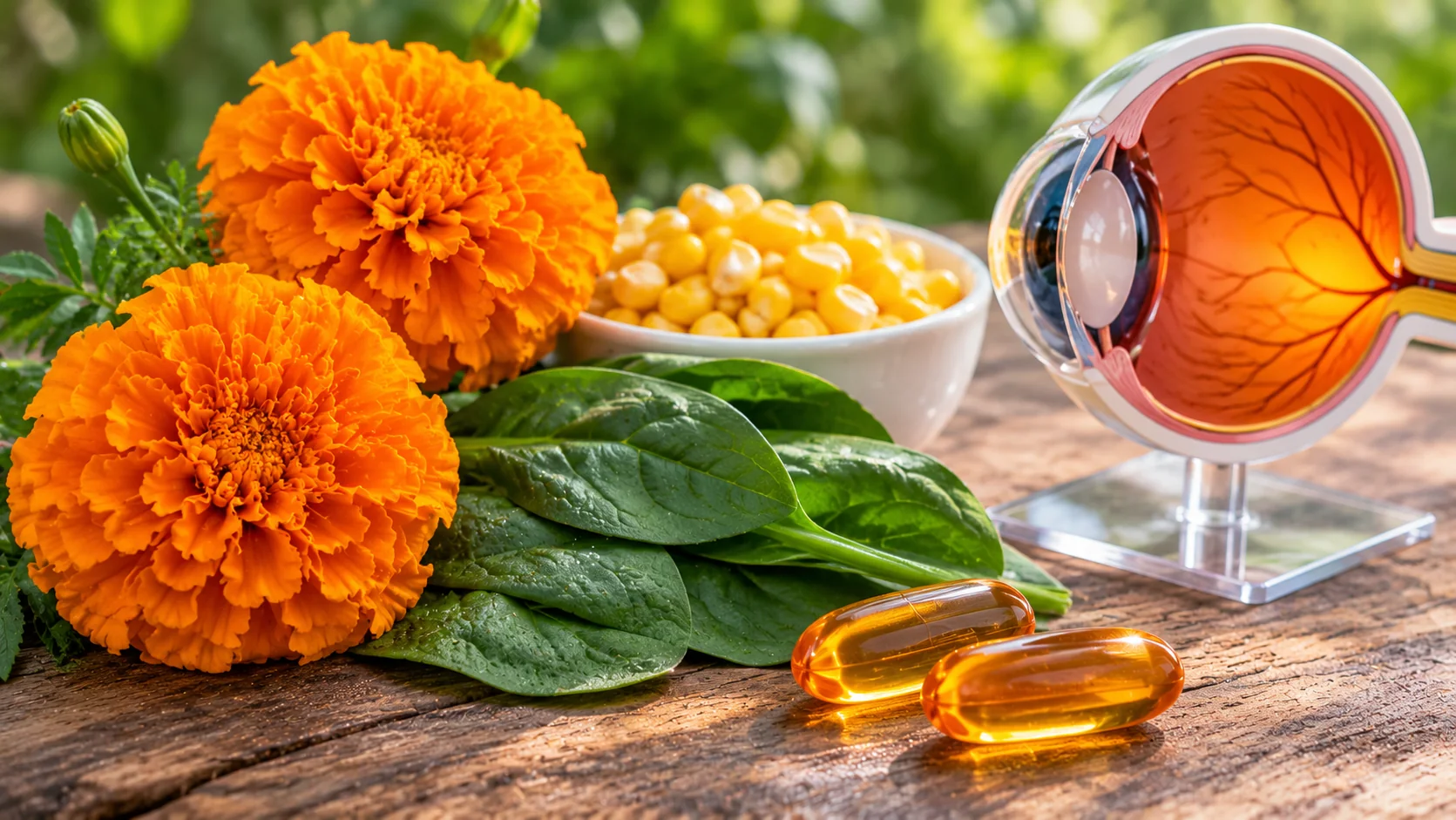
Lutein is a yellow-orange carotenoid found in foods such as kale, spinach, collard greens, peas and egg yolks. It accumulates in the macula, a region of the retina involved in central vision. Lutein is often discussed with zeaxanthin because both carotenoids are present in macular tissue. The strongest clinical context for supplemental lutein is its use as part of the specific AREDS2 formulation for people with certain stages of age-related macular degeneration (AMD). That evidence does not show that lutein supplements prevent AMD in people who do not have it, nor does it prove that a standalone lutein capsule or any branded blend improves eyesight in everyone.
The National Eye Institute's AREDS2 formula contains 10 mg lutein and 2 mg zeaxanthin alongside vitamin C, vitamin E, zinc and copper. The trial studied a defined combination in a defined population. It is not evidence that any supplement containing lutein is equivalent. People with AMD should ask an ophthalmologist whether an AREDS2 formulation is appropriate for their diagnosis and disease stage.
Lutein at a glance
| Question | What research or nutrition sources indicate | Important limitation |
|---|---|---|
| Where is it found? | Leafy green vegetables and other foods; it is also present in the retina. | Food presence does not mean a supplement improves eyesight. |
| AREDS2 context | 10 mg lutein was included with 2 mg zeaxanthin in the studied AREDS2 formulation. | The findings apply to defined AMD populations, not everyone. |
| Prevention claim | AREDS2 did not show that the formula prevents AMD from starting. | Do not describe lutein as proven AMD prevention. |
| Product comparison | Check the exact amount per serving and the full formula. | A label amount alone does not establish product effectiveness. |
What does lutein do in the body?
Lutein belongs to a group of plant pigments called carotenoids. Unlike some carotenoids, lutein is not converted into vitamin A in the body. It is found in several tissues, including the retina. The macula contains a concentration of lutein and zeaxanthin often referred to as macular pigment. Researchers study these pigments because of their location and their light-absorbing and antioxidant properties in biological systems.
These mechanisms help explain why lutein is researched in relation to eye health, but a plausible mechanism is not the same as a proven clinical outcome. A nutrient can be present in a tissue and participate in normal physiology without a supplement providing extra benefit to every person. Whether a supplement changes a health outcome depends on baseline diet, nutritional status, the dose, formulation, absorption, length of use, age, diagnosis and the outcome measured in the study.
It is also important to distinguish the role of lutein in a healthy diet from the role of a high-dose supplement. Foods contain mixtures of nutrients, fiber and other compounds. A capsule delivers a concentrated amount and may be taken alongside other products that contain overlapping ingredients. Those are different exposures and should not be treated as interchangeable.
Which foods contain lutein?
Green leafy vegetables are useful dietary sources of lutein. Kale, spinach, collard greens, turnip greens and other dark-green vegetables can contribute meaningful amounts. Broccoli, peas, corn and some other vegetables also contain carotenoids. Egg yolks contain lutein as well, although the amount is generally smaller than in a serving of some leafy greens. Food composition varies by variety, growing conditions, storage and preparation, so exact amounts are not fixed across every serving.
Eating a varied diet is a practical way to obtain carotenoids and other nutrients. Light cooking can soften vegetables and make them easier to eat; adding a modest amount of fat to a meal may help absorption of fat-soluble carotenoids. These are general nutrition considerations, not a guarantee that a particular meal will change vision or treat an eye condition.
People who dislike leafy greens can consider other vegetables, frozen produce, soups, salads, omelets or blended dishes. The aim is a sustainable eating pattern rather than a single “superfood.” A balanced diet also supplies nutrients that are not included in a lutein supplement. A supplement should not become a reason to neglect dietary variety or routine eye care.
What did the AREDS2 study find?
The Age-Related Eye Disease Study 2 (AREDS2) was a large clinical trial conducted by the National Eye Institute. It examined whether adding lutein and zeaxanthin, omega-3 fatty acids, or both to an existing AREDS nutrient formulation affected progression of AMD. The lutein/zeaxanthin combination tested was 10 mg lutein and 2 mg zeaxanthin per day. The research involved people already at increased risk because they had intermediate AMD in both eyes or intermediate AMD in one eye and advanced AMD in the other.
The overall AREDS2 findings need careful reading. Adding lutein and zeaxanthin to the original AREDS formula did not produce an additional overall effect on the primary risk of advanced AMD in the main comparison. Subsequent analyses and longer follow-up supported replacing beta-carotene with lutein and zeaxanthin in the AREDS formulation. This is one reason current AREDS2-style products omit beta-carotene. Beta-carotene in the original formula was associated with increased lung cancer risk in current and former smokers.
The key point for consumers is that the evidence relates to a specific combination and a population with established AMD risk. The NEI reports that AREDS/AREDS2 supplements can reduce the risk of progression from intermediate to advanced AMD by about 25 percent, but they do not prevent AMD from starting. The results do not establish that lutein alone has the same effect, that a person without AMD will benefit, or that a commercial product with a different formula will produce the same result.
For more detail, see the NEI's AREDS/AREDS2 clinical-trial summary and AREDS/AREDS2 frequently asked questions.
Does lutein prevent macular degeneration?
Current evidence does not establish that taking a lutein supplement prevents AMD from developing in a person who does not have the disease. The NEI explains that AREDS and AREDS2 supplements do not prevent AMD onset. The benefit identified in the research concerns slowing progression in people who already have particular stages of AMD. This distinction matters because “prevention” and “slowing progression” are different outcomes in different populations.
Nor should lutein be described as a cure, a way to reverse retinal damage, or a substitute for treatments used for wet AMD. A person who notices central blur, distortion, a new blind spot or sudden vision changes should seek professional eye assessment. Nutritional supplements are not a replacement for diagnosis, monitoring or indicated medical treatment.
Research on lutein for other eye conditions, including cataracts, dry eye disease and glaucoma, is not equivalent to the AREDS2 evidence. The National Center for Complementary and Integrative Health summarizes the evidence for supplements across eye conditions and notes that findings vary by condition. For example, it does not support treating glaucoma with vitamin supplements. Claims should be tied to the actual condition and study outcome rather than generalized to “better vision.”
How to compare lutein supplements
Start with the Supplement Facts panel, not the front label. Confirm the amount of lutein per serving, how many capsules make up a serving, and whether zeaxanthin is included. Check the ingredient source and whether the manufacturer discloses the form or standardization. If the label lists a proprietary blend without individual amounts, you cannot reliably compare its lutein dose with a clinical study.
Next, look at the rest of the formula. A product may contain vitamin C, vitamin E, zinc, copper, beta-carotene, herbs or other nutrients. Those ingredients may overlap with a multivitamin or another eye supplement. The combined daily intake matters more than the amount in one bottle viewed in isolation. If a product is promoted as “AREDS2,” compare all six nutrient amounts with the NEI formula rather than relying on a marketing badge or one matching ingredient.
Also consider quality and transparency. A label should identify the manufacturer or responsible company, serving size, full ingredient list, other ingredients, lot number and expiration date. Independent quality certification, when present, may provide information about identity or manufacturing quality, but it does not prove that a supplement improves vision. Do not confuse a manufacturing certification with clinical efficacy evidence.
Finally, compare price by serving rather than bottle. Divide the total checkout cost by the number of daily servings, and include shipping and tax. A larger bottle may lower the cost per serving but can increase the amount spent before you know whether the product suits you. Check refund terms and whether a purchase is one-time or recurring.
Are lutein supplements safe?
Lutein is present in foods and has been used in supplement studies, but no supplement is automatically appropriate for every person. Safety depends on dose, product quality, other ingredients, medications and health circumstances. People who are pregnant, breastfeeding, managing a chronic condition or taking prescription medicines should discuss a new supplement with a qualified health professional.
When a lutein product is part of a broader eye formula, review every ingredient. Zinc can interact with certain antibiotics and penicillamine. High supplemental vitamin E may be relevant to bleeding risk, and botanical ingredients can have their own interaction profiles. A product containing multiple ingredients requires a complete review rather than a decision based on lutein alone.
People with diagnosed AMD should ask their ophthalmologist whether an AREDS2 formulation is suitable. People with no AMD should not assume that taking a high-dose eye supplement will prevent future disease. A balanced diet and regular comprehensive eye examinations remain important parts of eye health. Do not delay care for new symptoms because you are trying a supplement.
What does the lutein amount on an eye supplement label mean?
A label amount tells you how much of the nutrient the manufacturer declares in a serving. It does not tell you how much reaches the retina, whether the product is absorbed in the same way as the preparation used in a clinical trial, or whether the dose is appropriate for your health situation. The AREDS2 amount of 10 mg lutein is meaningful because it was part of a defined research formulation, not because 10 mg is a universal target for every adult.
Some products list substantially more lutein than the AREDS2 amount. A higher number is not proof of greater benefit. More is not always better, and there may be no clinical evidence that a larger amount produces a better outcome. A product can also combine lutein with many other ingredients, making it difficult to attribute any perceived change to one component.
When a supplement company cites a study, ask four questions: Was the study conducted on the finished product or on an isolated ingredient? Was the ingredient the same form and standardization? Was the dose comparable? Were the participants and outcomes relevant to the claim? If the answer to these questions is unclear, the study may provide background context but not direct proof for the product being sold.
How lutein and zeaxanthin appear in food and research
| Context | What to compare | What it does not prove |
|---|---|---|
| Food sources | Kale, spinach, collard greens, peas and egg yolks contain lutein; amounts vary. | A food list is not a precise supplement-dose conversion. |
| AREDS2 research | The studied formula included 10 mg lutein and 2 mg zeaxanthin with other nutrients. | This is not a universal target for all adults. |
| Product label | Check the declared amount per serving, serving size and nutrient form. | A higher milligram amount does not establish greater benefit. |
AREDS2 findings apply to the studied formulation and eligible AMD population, not every lutein product.
Lutein FAQs
Does lutein improve eyesight?
Lutein is present in the macula and has been studied in eye-health research, but evidence does not show that a lutein supplement reliably improves eyesight in everyone. The strongest clinical context is lutein combined with zeaxanthin as part of AREDS2 for certain people with AMD.
How much lutein was used in AREDS2?
The AREDS2 formulation included 10 mg of lutein and 2 mg of zeaxanthin daily, alongside vitamin C, vitamin E, zinc and copper. The combination was studied in people with defined stages of AMD risk; it is not a general dose recommendation for every person.
Can lutein prevent macular degeneration?
There is no established evidence that lutein supplements prevent AMD from starting. NEI findings for AREDS2 concern reducing progression risk in certain people who already have intermediate AMD or advanced AMD in one eye.
Which foods are high in lutein?
Kale, spinach, collard greens and other dark leafy vegetables are useful food sources. Peas, broccoli, corn and egg yolks also contain lutein. Amounts vary by food variety and preparation.
Is lutein the same as zeaxanthin?
No. Lutein and zeaxanthin are related carotenoids that are both found in the macula, but they are distinct compounds. AREDS2 studied them together in a specific daily combination.
Should everyone over 50 take lutein?
No universal recommendation applies to everyone over 50. Whether a supplement is useful depends on diagnosis, diet, other health factors and the evidence for the specific product. Discuss individual needs with an eye-care professional.
Is a product with 20 mg lutein better than one with 10 mg?
A higher label amount does not establish better results. The 10 mg amount in AREDS2 was tested as part of a specific formula and population; it does not prove that doubling the amount improves outcomes.
Can I take lutein with other supplements?
Possibly, but check for duplicated nutrients and interactions across the complete formula. If another supplement contains zinc, vitamin E, vitamin A or botanical extracts, ask a pharmacist or clinician to review the combined daily intake.
Sources and further reading
- National Eye Institute — AREDS/AREDS2 Clinical Trials.
- National Eye Institute — AREDS/AREDS2 FAQs.
- NCCIH — Six Things to Know About Dietary Supplements for Eye Conditions.
- Cochrane — Antioxidant vitamin and mineral supplements for AMD.
- American Academy of Ophthalmology — Vitamins for AMD.
Last reviewed for this draft: November 12, 2026. Evidence summaries should be rechecked before publication. This article is an educational draft and requires human editorial review.